Astaxanthin
Buy Astaxanthin – Carotenoid from the Alga Haematococcus pluvialis
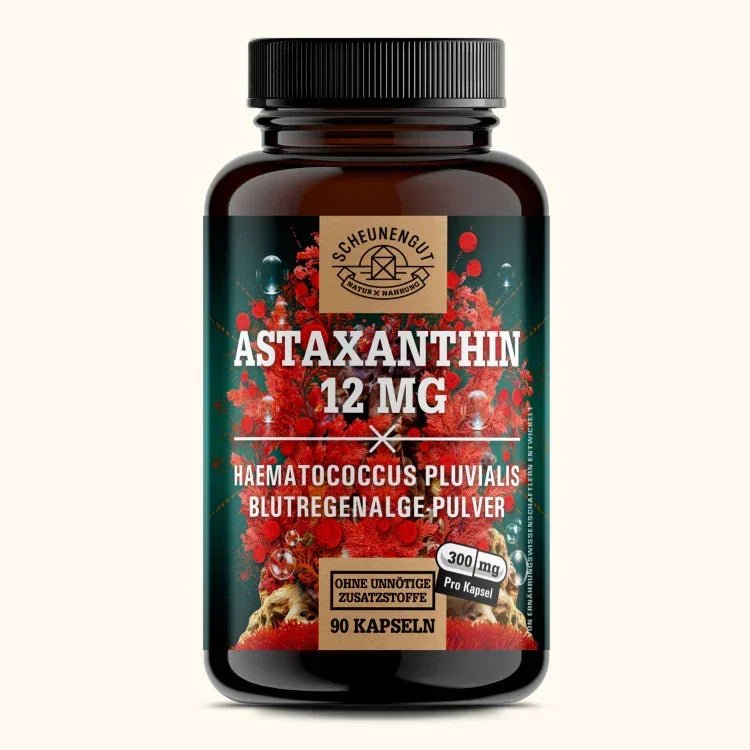
Astaxanthin is a natural carotenoid and thus one of the secondary plant compounds. It gives the microalga Haematococcus pluvialis its deep red colour and is a fat-soluble, pigment-forming plant compound from the group of xanthophylls. In this category, you'll find astaxanthin products from Scheunengut – obtained from algae, vegan and lab-tested.
Origin & Extraction
The most important natural source of astaxanthin is the freshwater microalga Haematococcus pluvialis. Under certain conditions, the alga accumulates the red pigment, which is then gently extracted from the biomass. Alongside astaxanthin, lutein and zeaxanthin also belong to the carotenoids.
Standardisation & Format
Because astaxanthin is fat-soluble, it is usually offered as an oil-based capsule or as an algae powder. The decisive factor is the standardised astaxanthin content, transparently declared in milligrams. As a raw material from algae, it combines well with other plant-based extracts.
What to Look for When Buying
- Standardised, transparently declared astaxanthin content in mg
- Sourced from the alga Haematococcus pluvialis
- Vegan, without unnecessary additives
- Independently lab-tested quality
Astaxanthin at Scheunengut
We rely on standardised algae raw materials, bottled and lab-tested in Germany. Related plant compounds include OPC and resveratrol. All products are vegan.

Häufige Fragen zu Astaxanthin
What is astaxanthin valued for?
Astaxanthin belongs to the carotenoids and, more broadly, to the group of secondary plant compounds. It is the deep red, fat-soluble pigment of the microalga Haematococcus pluvialis and belongs to the xanthophyll family. Astaxanthin is valued above all as a natural, algae-based carotenoid. Together with lutein and zeaxanthin, it is one of the best-known plant pigments from the world of microalgae.
What is astaxanthin extracted from?
The most important natural source is the freshwater microalga Haematococcus pluvialis. Under certain conditions, the alga accumulates the red pigment, which is then gently extracted from the biomass. This produces a purely plant-based, vegan carotenoid with no animal-derived starting materials. Our astaxanthin is lab-tested and bottled in Germany.
What should I look for when buying astaxanthin?
What matters most is the standardised astaxanthin content per serving and origin from the alga Haematococcus pluvialis rather than synthetic imitations. Because astaxanthin is fat-soluble, oil-based capsules are a good fit. Also look for lab-tested purity without unnecessary additives. At Scheunengut, you'll find algae-based astaxanthin in tested quality, vegan and transparently declared.
What forms does astaxanthin come in?
Because astaxanthin is fat-soluble, it is usually offered as an oil-based capsule, so it dissolves well in a fat-containing environment. Astaxanthin is also available as algae powder. For both forms, what matters is a clearly declared, standardised astaxanthin content, so you know exactly how much of the carotenoid is in every serving.
Related guides for Astaxanthin
Well-founded knowledge from our editorial team – free to read.