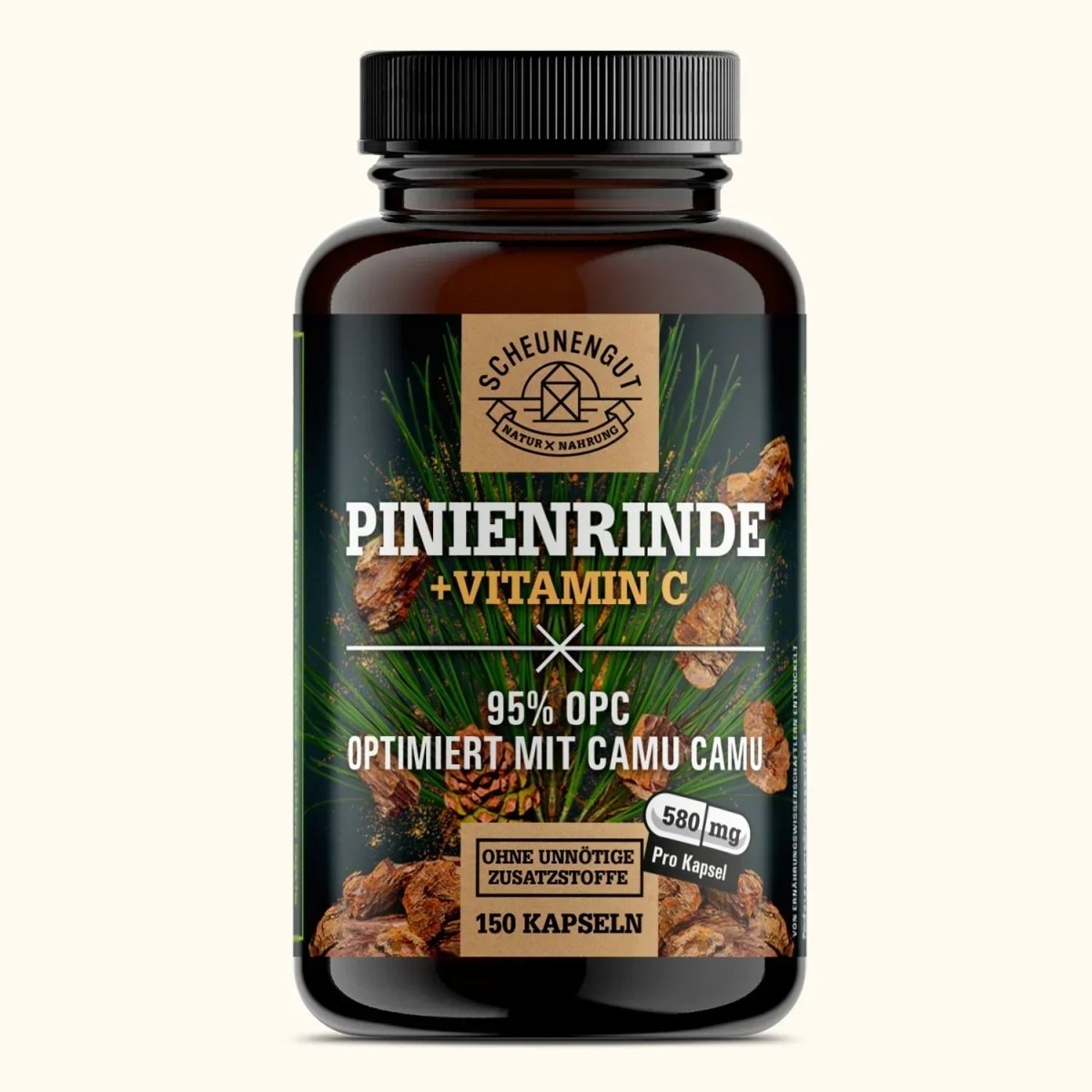
Pine Bark
Buy Pine Bark – Extract From the French Maritime Pine
Pine bark refers to the bark of the French maritime pine (Pinus pinaster), which grows on the Atlantic coast of southwestern France. Its extract belongs to the secondary plant compounds and is rich in OPC (oligomeric proanthocyanidins) from the group of polyphenols. In this category you'll find pine bark extract from Scheunengut – standardised, vegan and lab-tested.
Origin & Extraction
The raw material comes from the bark of the maritime pine. The extract is gently obtained from it and standardised to its content of oligomeric proanthocyanidins. Botanically related is the extraction of OPC from grape seed.
Standardisation & Form
What matters is the standardised OPC content: high-quality pine bark extracts often show around 95% OPC, often in a concentrated extract ratio such as 25:1. Pine bark is mostly offered as capsules, less often as powder – frequently combined with natural vitamin C.
What to Look for When Buying
- Standardised, transparently declared OPC content
- Origin from the French maritime pine, clearly stated extract ratio
- Vegan and free from unnecessary additives
- Independently lab-tested quality
Pine Bark at Scheunengut
We rely on high-dose, standardised raw materials. Related topics include OPC, resveratrol and quercetin. All products are bottled in Germany and lab-tested.

Häufige Fragen zu Pine Bark
What is pine bark extract valued for?
Pine bark is a popular plant extract, prized above all for its high content of OPCs, the oligomeric proanthocyanidins. These plant compounds from the polyphenol group have traditionally been valued in connection with topics such as cell protection and vascular health. This makes pine bark one of the classic antioxidant plant extracts.
Where does pine bark come from?
The raw material is the bark of the French maritime pine (Pinus pinaster), which grows along the Atlantic coast of southwestern France. The extract is gently obtained from this bark and standardised to its content of oligomeric proanthocyanidins. A botanically related source is OPC extracted from grape seeds.
What does an OPC content of 95 percent mean?
The OPC content shows the proportion of valuable proanthocyanidins in the extract. High-quality pine bark extracts often state around 95 percent OPC, frequently in a concentrated extract ratio such as 25:1. This figure is the key quality criterion to check before buying.
What forms does pine bark come in?
Pine bark is mostly offered as a capsule, less often as a powder, since this makes the standardised OPC content easy to dose accurately. The capsule is convenient for everyday use and has no noticeable taste. Our pine bark extracts are standardised, vegan, and lab-tested.

Related guides for Pine Bark
Well-founded knowledge from our editorial team – free to read.