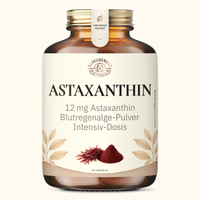




Five things matter when buying astaxanthin: natural astaxanthin from the microalga Haematococcus pluvialis, the milligrams of pure astaxanthin per serving, taking it after a meal with some fat, a lab report for the batch, and the price per milligram instead of per pack. Our capsule delivers 12 mg, one capsule every second day.
Five things decide when you buy astaxanthin: the origin from the microalga Haematococcus pluvialis, the milligrams of pure astaxanthin per serving, taking it with a meal that contains some fat, a lab report for the batch, and the price per milligram instead of per pack. If you can find these details on the label or the product page, you can compare offers cleanly.
Astaxanthin is the red plant pigment that colours salmon, shrimp and flamingos. It belongs to the carotenoids and is regarded as a strong antioxidant that intercepts free radicals; it is especially popular with people who spend a lot of time in the sun or in front of a screen, and with anyone who wants to protect their cells in a targeted way. Our capsule delivers 12 mg of pure astaxanthin from French algae farming. This guide shows you how to recognise that kind of quality, no matter where you buy.
What to look for when buying astaxanthin so you don't end up with a poor-quality product
With astaxanthin, poor quality usually means an unclear origin, an unclear content or no proof. All three can be checked before you buy, and without a lab. Start with the ingredient list, because it should say “Haematococcus pluvialis” followed by the astaxanthin share in percent, in our case “algae powder (2% astaxanthin)”. The calculation is short: 600 mg of algae powder at 2% gives 12 mg of pure astaxanthin. A line such as “100 mg algae extract” without a percentage tells you nothing about the content, because neither the share nor the amount of pure astaxanthin is visible, and lines like that are the ones to rule out.
- Origin: natural astaxanthin from Haematococcus pluvialis, named explicitly
- Content: milligrams of pure astaxanthin per capsule and per day, instead of mere algae powder
- Intake: capsule with a meal that contains some fat
- Proof: a current lab report for the batch that you can view
- Ingredients: short list, plant-based shell, no fillers or additives
- Storage: cool and dry, away from direct sun and heat
- Calculation: price per milligram of astaxanthin and duration in days
At Scheunengut, we have all raw materials and the finished products of every batch tested for purity and active-ingredient content in independent laboratories. You will find the current lab report as a file on the product page, and we send a detailed analysis report on request.
Natural or synthetic: why the alga makes the difference
Astaxanthin can be produced from algae, from yeast or chemically. The natural source for people is mainly the microalga Haematococcus pluvialis, which stores up to 3.8% of its dry weight as astaxanthin and is the richest known source. The alga produces the (3S,3'S) form of the molecule, whereas synthetic astaxanthin is a mixture of three different spatial forms that therefore matches the alga's molecule only in part.
A review on the safety of astaxanthin concludes that results with synthetic astaxanthin cannot be transferred to the natural form. For you, that means the alga has to be named on the label. The pigment alone is not enough.
Buying Haematococcus pluvialis: algae powder under the microscope
Behind “Haematococcus pluvialis powder” stands the dried blood rain alga. Our alga grows on a farm in western France. The farm harvests it green and moves it into special rooms with gentle UV light, where it is put under controlled stress and forms its red astaxanthin, and afterwards we fill the powder into plant-based capsules made of hydroxypropyl methylcellulose, without additives, colourings or fillers. Production takes place in Germany and Europe (incl. Switzerland, Austria).
Astaxanthin dosage: how much per day?
Counting is done in milligrams of pure astaxanthin, not milligrams of algae powder. In research with people, daily amounts range from a few milligrams up to 12 mg and more. A review evaluated 87 such investigations and found no safety concerns for natural astaxanthin, including 35 with 12 mg or more a day.
Our capsule contains 12 mg of astaxanthin, and the intake recommendation is one capsule every second day. That averages 6 mg a day. With 120 capsules, one tub therefore lasts 240 days, around eight months, without you having to work out the dosage in daily life. The intake amount on the label applies.
Which astaxanthin format should you buy?
Astaxanthin is fat-soluble. That matters more for absorption than the type of capsule. In research with people, absorption rises when fat is present and falls on a low-fat diet. Whether it is an oil capsule or algae powder in a plant-based capsule, you take both best with a meal containing nuts, avocado, yoghurt or a spoonful of oil, so that fat is on hand as a companion.
If you eat vegan or vegetarian, also look at the shell. Our capsule is made of hydroxypropyl methylcellulose and is therefore plant-based, with no animal gelatine at all. The contents come from the alga, the shell from plant cellulose. Because astaxanthin is a substance prone to oxidation, the capsules are tailored to it, and you store the tub cool and dry, away from direct sunlight and heat.
Is expensive astaxanthin worth it, or is a cheap supplement enough?
The pack price does not answer that. The price per milligram of pure astaxanthin does. To get it, divide the price by the milligrams in the whole pack; with us that is 120 capsules of 12 mg each, so 1,440 mg of pure astaxanthin per tub. If you do the same calculation for every offer, algae powders at 2%, softgels with a few milligrams and extracts of unclear content suddenly sit on the same scale, and the comparison is easy.
Duration counts as well. One tub lasts eight months. A very low price combined with a high milligram figure deserves a question about the raw material and the percentage.
Which astaxanthin is the best? Our buying recommendation in six points
The best astaxanthin is the one where every detail can be checked. As a buying recommendation for you, this applies:
- Raw material: natural astaxanthin from Haematococcus pluvialis
- Content: milligrams of pure astaxanthin per capsule clearly stated
- Intake: after a meal with some fat
- Proof: lab report for the batch, current and viewable
- Shell: plant-based, a must for a vegan diet, few additives
- Calculation: price per milligram and duration in days
Our capsule meets all six points: Haematococcus pluvialis from western France, 12 mg of pure astaxanthin, a lab report for every batch on the product page, a plant-based shell without fillers and additives, and 240 days of supply per tub.
Where is astaxanthin found? Salmon, trout and the alga compared
In food, astaxanthin is found mainly in wild salmon. Red wild salmon (sockeye) brings 26 to 38 mg per kilogram of flesh, farmed salmon 6 to 8 mg, and trout between 6 and 25 mg depending on the market. A 165 g portion of wild salmon therefore delivers around 3.6 mg of astaxanthin, and even that applies only to wild-caught fish, because the values for farmed fish are clearly lower.
The alga is the concentrated source. For 12 mg, as much as in one of our capsules, you would need more than three portions of wild salmon by this calculation, and you would first have to get them onto your plate regularly. With the capsule, you manage entirely without fish.
Intake: after the meal, with some fat
The intake recommendation is to take one capsule every second day with enough fluid, preferably after a meal, and a breakfast with nuts, avocado or yoghurt works as well as a warm lunch with a little oil, as long as some fat is on the plate. If you also take vitamin D or omega-3, the same meal fits, because you take both best with fat anyway, and you have only one intake time to remember.
There is no fixed time of day. The easiest way is to tie the capsule to a meal you eat anyway, such as breakfast, so that taking it becomes a habit without you having to think about it. In case of pregnancy, breastfeeding, existing conditions or medication, discuss the intake beforehand with your doctor or pharmacist.
Matching Products from Scheunengut
Our astaxanthin consists of Haematococcus pluvialis powder from French, vegan algae farming: 12 mg of pure astaxanthin per capsule, high-dose and clearly more than in many standard products. We have every batch tested in an independent lab for purity and active-ingredient content, and 120 capsules at one capsule every second day last 240 days, so around eight months from a single tub. Since 2012, we at Scheunengut have worked without investors and with a focus on pure raw-material quality, and that standard is in this capsule too.
If you want to extend your antioxidant set, combine the astaxanthin with our knotweed extract: 500 mg of resveratrol per capsule, standardised to 98%, with piperine from black pepper.
Frequently Asked Questions (FAQ)
How do I recognise natural astaxanthin?
Natural astaxanthin comes from the microalga Haematococcus pluvialis. Its name appears in the ingredient list, ideally with the astaxanthin share in percent, for example “algae powder (2% astaxanthin)”. The alga produces the (3S,3'S) form of the molecule, whereas synthetic astaxanthin is a mixture of three forms. If the label says only “astaxanthin” with no raw material, it is worth asking the supplier.
What dosage of astaxanthin is typically used?
What counts is the milligrams of pure astaxanthin, not the milligrams of algae powder. In research with people, daily amounts range from a few milligrams up to 12 mg or more. Our capsule contains 12 mg of astaxanthin, and the intake recommendation is one capsule every second day, which averages 6 mg a day.
Which form of astaxanthin is absorbed best by the body?
Astaxanthin is fat-soluble, so absorption depends above all on dietary fat: with a meal that contains some fat, the body takes up more than on a low-fat diet. That applies to oil capsules and to algae powder in a capsule alike. With our capsule, the intake after a meal is added on top, as the label recommends.
How do I recognise a trustworthy astaxanthin supplement?
By details you can check: the raw material Haematococcus pluvialis, the astaxanthin share in percent, the milligrams per capsule, a current lab report for the batch, a short ingredient list without fillers and additives, and a clear intake recommendation. With us, the lab report for the batch is attached as a file to the product page.
When and how is it best to take astaxanthin?
Ideally after a meal with some fat, for example at breakfast with nuts, avocado or yoghurt, and with enough fluid. There is no fixed time of day. Taking it on an empty stomach is less worthwhile, because the fat is missing as a companion.
Where is astaxanthin found?
Mainly in wild salmon at 26 to 38 mg per kilogram of flesh, in farmed salmon at 6 to 8 mg, and also in trout, shrimp and krill. The most concentrated source is the microalga Haematococcus pluvialis, which stores up to 3.8% of its dry weight as astaxanthin.
Where is the best place to buy astaxanthin online?
Where origin, content and lab report are openly stated on the product page. With us you will find the algae powder with 12 mg of pure astaxanthin per capsule directly in the Scheunengut shop, together with ingredients, intake recommendation and the current lab report.
Health notice: This guide is for general information purposes only and does not replace individual medical or pharmaceutical advice. Food supplements are not a substitute for a balanced, varied diet and a healthy lifestyle. If you have health concerns, are pregnant or breastfeeding, or are taking medication, please consult a doctor or pharmacist. How our guides are created →
Sources
- EFSA: Safety of Astaxanthin as a Novel Food – Scientific Assessment and Maximum Levels — European Food Safety Authority (EFSA), 2020
- EU Novel Food Catalogue – Entry on Astaxanthin from Haematococcus pluvialis — European Commission, 2024
- Dietary Supplements: What Consumers Should Consider When Buying — Verbraucherzentrale, 2024
- Maximum Levels for Vitamins and Minerals in Dietary Supplements — German Federal Institute for Risk Assessment (BfR), 2021
- Ambati et al.: Astaxanthin: Sources, Extraction, Stability, Biological Activities and Its Commercial Applications – A Review — Marine Drugs / NCBI PMC, 2014
- Brendler, Williamson: Astaxanthin: How much is too much? A safety review — Phytotherapy Research, 2019
- Mercke Odeberg et al.: Oral bioavailability of the antioxidant astaxanthin in humans is enhanced by incorporation of lipid based formulations — European Journal of Pharmaceutical Sciences, 2003