



Yes, you can take selenium and zinc on the same day and with the same meal. No mutual inhibition is documented in humans. What matters is the total from food and all supplements. Add up every label; your food counts too.
Yes, you can take selenium and zinc on the same day, even with the same meal. None of the opinions and EU assessments on selenium and zinc that we have read mentions an interaction between the two. The catch is the amounts. You count selenium in micrograms and zinc in milligrams, and between the two sits a factor of 1,000.
Your plan in one sentence: zinc at breakfast or lunch, selenium alongside or in the evening, and add up every label you swallow in a day. Anyone who takes a multivitamin, an immune complex and a single capsule side by side loses track of the total faster than they think.
What selenium and zinc can do together
The EU permits statements for both substances, and they overlap at several points: immune system, cell protection, hair and nails, reproduction. That's why the question about the combination comes up so often.
- Selenium contributes to the normal function of the immune system. Zinc contributes to the normal function of the immune system.
- Selenium contributes to the protection of cells from oxidative stress. Zinc contributes to the protection of cells from oxidative stress.
- Selenium contributes to the maintenance of normal hair. Selenium contributes to the maintenance of normal nails. Zinc contributes to the maintenance of normal hair, skin and nails.
- Selenium contributes to normal spermatogenesis. Zinc contributes to normal fertility and reproduction. Zinc contributes to the maintenance of normal testosterone levels in the blood.
Then there is what each brings on its own. Selenium contributes to normal thyroid function. Zinc contributes to normal cognitive function and to the maintenance of normal vision. So if you take both, you aren't covering the same ground twice. You're covering two lists that touch at a few points.
Do selenium and zinc get in each other's way?
In humans, we know of no evidence that the two slow each other down at usual supplement amounts. We went through the literature on selenium and on zinc. The other substance doesn't appear in any of it. That's no proof, because if nobody asks about an interaction, nobody finds one. But it is a finding.
There is a counterpoint. A Polish study from Łódź gave 180 rats zinc gluconate and selenium for three months, alone and together. With selenium, liver zinc was about 26 % higher after 30 days than with zinc alone; later this evened out. In one part of the prostate, the rise in zinc was no longer significant. The authors write that the two should not be given together. That is an animal experiment with six animals per group. It doesn't transfer to your breakfast table.
In practice: you don't have to separate them. You can, though, and it costs you neither money nor effort. Zinc with lunch, selenium with dinner, done.
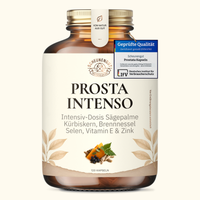
The same goes for complexes that already contain both: Prosta Intenso brings 5 mg of zinc and 55 µg of selenium with the 2 capsules of the daily dose, plus 10 mg of vitamin E.
How much selenium and how much zinc make sense?
This is where it's decided whether the combination suits you. The numbers worth knowing:
- Selenium, requirement: The German-speaking nutrition societies give an estimated adequate intake of 60 µg a day for women and 70 µg for men. EFSA puts the average intake of adults in EU countries at 31 to 66 µg.
- Selenium, total amount: Add up food, multivitamin and single capsule. The serving recommendation on the label applies.
- Zinc, requirement: Depending on the phytate content of your diet, the recommended intake is 7 to 10 mg for women and 11 to 16 mg for men. More wholegrain and pulses means more phytate and therefore a higher reference value.
- Zinc, total amount: What counts is the total across all labels. If you take high amounts for a long time, have your copper status checked with a blood test.
Do count your diet too. In the National Consumption Study II, women reached a median of 8.6 to 9.5 mg of zinc a day, men 10.4 to 12.3 mg. With Prosta Intenso (5 mg of zinc), a woman lands at around 14 to 15 mg, with the Stammkraft Maca Complex (10.5 mg) at around 19 to 20 mg. A man reaches 21 to just under 23 mg with Stammkraft. All of it well under 25.
A worked example shows how fast zinc adds up. An immune complex with 5 mg, a multivitamin with 10 mg and a single capsule with 5 mg come to 20 mg before you've eaten a bite. With food on top, it adds up further.
With us, the amount is on the label: Prosta Intenso delivers 5 mg of zinc (50 % of the nutrient reference value) and 55 µg of selenium (100 %) per daily dose, and the T3 T4 Thyroid Complex 55 µg of selenium in one capsule. Both are on the label, and you add them to the rest of your day.
With selenium, take a second look. Hair loss is the best-known result of too much. In the SELECT trial, hair loss and mild skin changes occurred more often than with placebo at 200 µg of selenium a day over several years. Anyone taking selenium for hair and nails should know this: more is not better here.
In the long run, copper is the bigger zinc issue
Zinc most likely doesn't quarrel with selenium. With copper it does. A lot of zinc over a long time can lower copper status, and that is where the interaction lies. If you take high zinc amounts for the long term, have your copper level checked by a doctor.
At the 5 to 10.5 mg of zinc found in our complexes, you are far from that. But if you take zinc in higher doses for months, it's better to steer clear of the "more is better" principle.
How to fit both into your day
- Zinc with a meal. Breakfast or lunch. Many people tolerate it better with something in the stomach than on an empty one.
- Selenium alongside or in the evening. We know of no requirement for the timing of selenium; take it whenever you won't forget. After a few weeks, ask yourself whether you still need it.
- Combination product? With Prosta Intenso it is 2 capsules a day with a large glass of water, preferably with a meal. You add every further product on top.
- Medication? If you take some regularly, for example for the thyroid, ask at the pharmacy whether a gap is needed.
Do you need anything at all? That depends on your plate. If you eat mostly plant-based with wholegrain and pulses, expect higher reference values for zinc, because phytates slow absorption, and if you rarely eat fish, eggs or meat, you are more likely to be borderline on selenium. A blood value from your doctor turns a gut feeling into a number, and a complex with a fixed 55 µg of selenium makes your daily amount predictable.
Reading the label properly
Always compare like with like. 200 µg of selenium is 0.2 mg, not 200 mg. This is the most common number mix-up with this combination.
Also check whether the number refers to the element or to the compound. Zinc gluconate is only around 14 % zinc, so 100 mg of zinc gluconate supply about 14 mg of zinc. Sodium selenite is around 46 % selenium, selenomethionine around 40 %. If only the compound is printed, you convert. The amount of the element is the only number you can compare with your needs and your other labels. On our labels it is there: 5 mg of zinc, 55 µg of selenium.
Matching Products from Scheunengut
Scheunengut has been around since 2012, without investors, with a focus on pure raw-material quality. Every batch goes to an independent lab, and we attach the latest report to the product page. We don't sell pure selenium or pure zinc. Both sit together in Prosta Intenso.
Prosta Intenso for men from midlife: 2 capsules a day with 5 mg of zinc, 55 µg of selenium and 10 mg of vitamin E, plus 700 mg of pumpkin seed extract, 360 mg of saw palmetto berry extract and 125 mg of nettle root extract. The pumpkin seeds and nettle roots come from Germany, the saw palmetto berries from Mississippi. Selenium contributes to normal spermatogenesis. Zinc contributes to the maintenance of normal testosterone levels in the blood. Vitamin E contributes to the protection of cells from oxidative stress. Prosta Intenso+ delivers the same 5 mg of zinc and 55 µg of selenium.
For selenium in everyday life: the T3 T4 Thyroid Complex with Iodine, Selenium and Thyme, with 55 µg of selenium as L-selenomethionine and 155 µg of iodine in one capsule. Selenium contributes to normal thyroid function, and iodine to the normal production of thyroid hormones. The thyme comes from Italy, the kelp from Japan. 180 capsules last six months at one capsule a day. If you take thyroid medication, check the intake with your doctor first.
For zinc as part of a strength complex: the Fadogia strength complex with 5 mg of zinc as bisglycinate and 1,000 mg of Fadogia agrestis extract 10:1 in 2 capsules, and the Stammkraft Maca Complex with 10.5 mg of zinc in 3 capsules. Both deliver zinc, which contributes to normal fertility and reproduction.
Frequently Asked Questions (FAQ)
Can I take selenium and zinc together?
Yes, even at the same time and in the same meal. In the opinions and EU assessments we read, there is no sign of mutual inhibition in humans. What matters are the amounts: selenium in micrograms, zinc in milligrams, all products added up.
Is there any reason not to take selenium and zinc together?
None proven in humans. One rat study saw more zinc in the liver at first with selenium, and less rise in zinc in one part of the prostate; the authors recommend separate dosing there. If you want to be safe, put zinc at lunch and selenium at dinner.
When is the best time to take selenium and zinc?
Zinc with a meal, as many people tolerate it better that way. Selenium has no fixed time; it fits dinner or the same table as the zinc. More important than the hour is that you take it regularly and stay within the label amounts.
How much selenium and zinc can I take per day?
Add up everything you get from food and supplements, and follow the serving recommendation on the label. Add up the labels of all your products. Prosta Intenso delivers 5 mg of zinc and 55 µg of selenium per daily dose, and your food comes on top.
What are zinc and selenium good for together?
Selenium and zinc contribute to the normal function of the immune system. Selenium contributes to the protection of cells from oxidative stress and to normal thyroid function. Zinc contributes to the maintenance of normal hair, skin and nails. The authorised statements say no more than that.
Can I take selenium and zinc long term?
At amounts close to your requirement, yes. With selenium the margin is narrow; with zinc, long term, it comes down to copper. If you take more than the recommendations above for months, discuss it with your doctor.
Do I need to watch for medication with selenium and zinc?
It depends on the medication, and we don't know yours. If you take any regularly, ask at the pharmacy first whether minerals need a time gap.
Health notice: This guide is for general information purposes only and does not replace individual medical or pharmaceutical advice. Food supplements are not a substitute for a balanced, varied diet and a healthy lifestyle. If you have health concerns, are pregnant or breastfeeding, or are taking medication, please consult a doctor or pharmacist. How our guides are created →
Sources
- The Effect of Zinc and Selenium Supplementation Mode on Their Bioavailability in the Rat Prostate. Should Administration Be Joint or Separate? — Daragó A et al., Nutrients 8(10):601, 2016
- Selenium: reference values for nutrient intake — German Nutrition Society (DGE)
- Zinc: reference values for nutrient intake — German Nutrition Society (DGE)