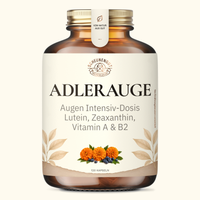




Lutein and zeaxanthin are two yellow carotenoids that your body cannot make itself. In the macula of the eye they filter light between 400 and 500 nm. Lutein is found mainly in kale and spinach (roughly 5 to 12 mg per 100 g), zeaxanthin in red peppers and sweetcorn; fat improves absorption.
Lutein and zeaxanthin are two yellow plant pigments from the carotenoid family that your body cannot make itself and that collect in the eye in a single place: the macula, the area of sharpest vision. There, together with meso-zeaxanthin, they form the macular pigment, which absorbs light in the range of 400 to 500 nm, exactly the high-energy blue portion that the sun and screens supply in plenty. Anyone who takes in both regularly through kale, spinach, peppers or a supplement supplies the spot where every detail counts.
On average, adults in Europe take in about 2.3 mg of lutein and zeaxanthin a day from food. That can be raised noticeably with a few simple habits.
Lutein: What Is It and Where Does It Come From?
Lutein belongs to the xanthophylls, the oxygen-containing carotenoids, and is fat-soluble. As a food colour it carries the number E161b. Naturally it is found in spinach, kale, broccoli, peppers, peas and sweetcorn, and also in nectarines, peaches, apricots, oranges and egg yolk. For food supplements it is usually obtained from the petals of the African marigold (Tagetes erecta).
Plants use carotenoids as a defence against UV light, and a similar principle protects the eye: lutein sits in the leaves of kale and spinach and, in humans, in the yellow spot of the retina. The fact that the body cannot build this pigment itself makes food the only source. Without intake there is no supply.
Zeaxanthin: What Is It and How Does It Differ from Lutein?
Zeaxanthin is the chemical sister of lutein. Both have the same molecular formula and differ only in the position of a single double bond, which is why they are called isomers. Meso-zeaxanthin, the third pigment of the macula, is made by the retina itself from lutein.
In the kitchen the two part ways: lutein is the speciality of kale and spinach, while zeaxanthin is found mainly in red peppers with 3.9 mg per 100 g and in sweetcorn with 0.84 mg. If you want to eat zeaxanthin on purpose, reach for the pepper in your salad; if you are after lutein, reach for leafy greens.
Carotenoids and Eyes: Who Else Belongs to the Family?
Lutein and zeaxanthin are not the only carotenoids mentioned in connection with the eyes:
- Beta-carotene is a carotene without oxygen and the precursor of vitamin A, so biochemically a different group.
- Astaxanthin is a xanthophyll like lutein, but comes from the microalga Haematococcus pluvialis.
- Lycopene is the red carotenoid of the tomato.
Each of them has its own focus. The duo of lutein and zeaxanthin is the only one that sits as macular pigment at the place of sharpest vision.
Lutein Effects: The Macular Pigment as a Light Filter
The macular xanthophylls shield the visual cells of the fovea from blue light and, as antioxidants, catch free radicals before they oxidise fatty structures in the retina. Your body therefore brings its own sun protection, provided it gets enough raw material.
How much raw material is needed has been measured in several investigations: in a 140-day dose study the density of the macular pigment rose in proportion to the amount with 5, 10 and 20 mg of lutein a day, and with twelve months of 10 mg lutein plus 1 mg zeaxanthin the increase was already clear. Pigment density can be raised through diet and through supplements, and that is the real lever for everyone who sits in front of a monitor and smartphone for many hours a day.
Lutein and the Brain: Why Researchers Are Looking There
Lutein is the carotenoid with the highest concentration in human brain tissue. In full-term infants it makes up around 60% of the carotenoids in brain tissue, although in the first year of life it accounts for only about 12% of carotenoid intake from food, and in centenarians it is still about 35%.
Several cross-sectional investigations found a link between macular pigment density and cognitive performance in adults and children. How this link arises is open; antioxidant effects and the protection of cell membranes from oxidation are under discussion. In pre-pubertal children, four cross-sectional studies found connections between the macular pigment and memory, school performance or executive functions. These are observations, not a treatment, and they explain why the carotenoid draws interest far beyond the eye.
Spinach and Lutein: Which Foods Deliver the Most?
Green leafy vegetables are the strongest source. This is shown by the values per 100 g from an evaluation by the universities of Jena and Hohenheim:
- Kale: 4.8 to 11.5 mg of lutein
- Spinach: 5.9 to 7.9 mg of lutein (zeaxanthin included)
- Lettuce: 1.0 to 4.8 mg
- Peas: 1.9 mg
- Broccoli: 0.7 to 3.3 mg
- Egg yolk: 0.4 to 1.3 mg
A 150 g portion of spinach therefore delivers 9 to 12 mg of lutein by calculation, several times the usual daily intake of 2.3 mg. The range comes from variety, cultivation and harvest time.
Two kitchen rules get more out of it: fat promotes absorption, fibre slows it, and cooking makes lutein more available to the body. A splash of olive or rapeseed oil in steamed spinach is therefore more than flavour. Fat helps. Egg yolk supplies less lutein per 100 g but brings its fat along.
A calculation shows how far you get with the plate alone: 100 g of kale, a side salad of 100 g lettuce and 100 g of peas add up to 7.7 to 18.2 mg of lutein, which is the amounts used in the investigations. That works on days when kale is on the table. On all other days the capsule fills the gap, and that is exactly why we dosed our eye vitamins the way we did.
Dosing Lutein: Amount, Form and Quality in a Supplement
In the investigations the daily amounts were 5 to 20 mg of lutein, mostly together with zeaxanthin, and one capsule of our eye vitamins contains 20 mg of lutein and 4 mg of zeaxanthin, sits at the upper end of that range and, at one capsule a day, lasts 120 days because the pack holds 120 capsules. One capsule is enough. Both come from the marigold extract, which consists of 20% lutein and 4% zeaxanthin.
This is how you recognise a good supplement:
- Raw material: a standardised marigold extract with a stated lutein and zeaxanthin content.
- Amounts: clearly declared contents of lutein and zeaxanthin per daily portion in milligrams.
- Recipe: no fillers, colourings or additives, because the amounts of active ingredient are small and the rest of the capsule is only carrier.
- Laboratory testing: independent checks for purity and active ingredient content, ideally for every batch.
Because lutein is fat-soluble, the capsule belongs with a meal that contains some fat, for example breakfast with nuts or lunch with olive oil on the salad. The investigations run for 140 days up to twelve months; as an everyday rule that means: daily, with the same meal, so the capsule does not get forgotten.
Matching Products from Scheunengut
Our eye vitamins with lutein and zeaxanthin supply 20 mg of lutein and 4 mg of zeaxanthin per capsule, plus 2.5 mg of anthocyanidins from marigold and blueberry, vitamin A and vitamin B2. Vitamin A contributes to the maintenance of normal vision, vitamin B2 to the protection of cells from oxidative stress. The marigold is grown in Mexico and gently dried, the blueberries grow in Sweden; in Germany both raw materials are dual-extracted, with steam for all water-soluble and with food-grade alcohol for all fat-soluble constituents. You take one capsule a day, and the vegan capsule shell is free of carrageenan and PEG.
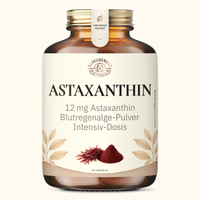
If you want to add the antioxidant from the microalga, complement it with our astaxanthin: 12 mg per capsule from the microalga Haematococcus pluvialis from western France, vegan, one capsule every other day. We have made both products as a family business without investors since 2012, focusing on pure raw-material quality, in Germany and Europe (incl. Switzerland, Austria) and with a laboratory test on every batch.
Frequently Asked Questions (FAQ)
What is lutein?
A fat-soluble, yellow carotenoid from the xanthophyll group. Your body does not make it itself; you take it in through leafy greens, peppers, sweetcorn, egg yolk or supplements made from marigold flowers. In the eye it collects in the macula and forms the macular pigment there with zeaxanthin.
What is zeaxanthin?
The chemical twin of lutein with the same molecular formula; only one double bond sits in a different place. Zeaxanthin is found mainly in red peppers (3.9 mg per 100 g) and sweetcorn (0.84 mg). Meso-zeaxanthin, the third pigment of the macula, is made by the retina itself from lutein.
What is lutein good for?
Lutein is a building block of the macular pigment and filters blue light between 400 and 500 nm. If you work a lot at a screen, you can use it as a targeted supplement to your diet. As a companion to vitamin A, our combination contributes to the maintenance of normal vision.
Which foods contain lutein and zeaxanthin?
Lutein mainly in kale (4.8 to 11.5 mg per 100 g) and spinach (5.9 to 7.9 mg), also in lettuce, peas, broccoli and egg yolk. Zeaxanthin in red peppers and sweetcorn.
Should you take lutein with fat?
Yes. Fat promotes absorption, fibre inhibits it. A splash of olive oil, rapeseed oil or a little butter with the vegetables is enough, and cooked vegetables are more available than raw.
What is lutein in supplements made from?
Mostly from the petals of the African marigold (Tagetes erecta), which contains a lot of lutein. Zeaxanthin can also be obtained from the same raw material. Lutein is offered as a free form or as lutein ester.
How do lutein and zeaxanthin differ from beta-carotene?
Beta-carotene is a carotene and the precursor of vitamin A, while lutein and zeaxanthin are oxygen-containing xanthophylls. All three belong to the carotenoids but fulfil different tasks in the body.
Health notice: This guide is for general information purposes only and does not replace individual medical or pharmaceutical advice. Food supplements are not a substitute for a balanced, varied diet and a healthy lifestyle. If you have health concerns, are pregnant or breastfeeding, or are taking medication, please consult a doctor or pharmacist. How our guides are created →
Sources
- Sharper Vision with Zeaxanthin? — Verbraucherzentrale, 2024
- Lutein – Eye Protection or Eyewash? — Verbraucherzentrale, 2025
- Zeaxanthin and Lutein in the Management of Eye Diseases — Journal of Ophthalmology (NCBI/PMC, Peer-Reviewed), 2016
- A Mechanistic Review of β-Carotene, Lutein, and Zeaxanthin in Eye Health and Disease — Antioxidants (Basel) (NCBI/PMC, Peer-Reviewed), 2020
- Lutein across the Lifespan: From Childhood Cognitive Performance to the Aging Eye and Brain — Current Developments in Nutrition (NCBI/PMC, Peer-Reviewed), 2019
- Pasta from domestic durum wheat is an interesting dietary source of the carotenoid lutein (table: lutein and zeaxanthin in foods) — University of Jena and University of Hohenheim, 2016