
You can take shilajit as a resin, which you dissolve in warm water or a beverage, or as a pre-dosed capsule. With the resin, a rice-grain to pea-sized amount is a good guide, while with capsules the portion is already measured out. The recommended serving on the package is always the deciding factor.
You can take Shilajit either as resin, which you dissolve in warm water or a drink, or simply as a pre-dosed capsule. With resin, you're aiming for a small amount — about the size of a grain of rice to a pea — while with capsules, the portion is already measured out for you. The recommended intake on your packaging is always the deciding guide — it tells you the amount intended for your specific product. It works best as a fixed, daily routine.
Taking Shilajit Correctly — The Two Routes
Shilajit, also traditionally known as Mumijo, is a mineral-rich natural resin from the high mountains of the Himalayas and the Altai. Its character comes from the combination of fulvic acid, humic acid, and a broad spectrum of trace elements. This resin is the starting point — and from it come the two practical ways to take it: the pure resin, which you dissolve yourself, and the capsule or extract, which comes already dosed.
Which option suits you better is mainly a question of routine and preference. The resin is the original, very direct form, but it takes a bit of handling and has a strong, distinctive taste. The capsule is the practical solution for on the go, tasteless, and always dosed the same way. We've laid out both sides in detail in our comparison Shilajit Resin or Capsules.
Dissolving the Resin — Step by Step
Dissolving Shilajit resin is easier than it looks the first time. All you need is warm water, a glass, and a bit of patience. Here's how:
- Measure out a portion: Use the small spoon provided or a clean toothpick to take out a small amount. According to the recommended intake, this is usually a portion the size of a grain of rice up to a pea — the exact amount is stated on your packaging.
- Dissolve in warm water: Put the piece into a glass of warm (not boiling) water, warm milk, or tea. There's no need for very hot liquid; body-warm to lukewarm is completely enough.
- Stir: Stir briefly or let it sit for one to two minutes. The resin dissolves into a dark liquid.
- Drink: Drink the solution promptly. The taste is earthy and slightly bitter — if you want to soften it, combine the resin with cocoa, coffee, or a strong tea.
A practical tip: real Shilajit resin responds to warmth. At room temperature it's thick and sticky, while in the fridge it turns hard and brittle. Both are completely normal. If you warm the piece briefly between your fingers, it's easier to portion. You can read how to spot high-quality resin in our guide Buying Shilajit — What to Look For.
Capsules — The Simple Option
If dissolving resin feels like too much hassle, or you'd rather avoid the distinctive taste, capsules are the clearly more practical choice. The big advantage: the portion is already measured out. You don't need to weigh anything, estimate anything, or dissolve anything — you simply take the number of capsules stated on the packaging with enough water.
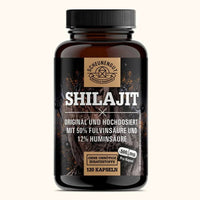
Capsules are tasteless, travel-friendly, and slot easily into an existing supplement routine. Anyone who wants to use Shilajit long-term and regularly especially appreciates the reliability of pre-dosing. Our Mumijo Shilajit capsules (lab-tested, 50% fulvic acid) are made for exactly that: clear portioning, tested quality, no handling resin.
With capsules, the same basic principle applies as with resin: the recommended intake on the packaging is the deciding guide. It tells you the intended daily portion to follow.
When & What to Take It With
There's no fixed rule when it comes to timing — what matters is finding a routine you can stick with reliably. Many users build Shilajit into their morning routine, since a fixed time is easy to remember. Others take it spread across the day or in the early afternoon. More important than the exact time is consistency.
What you combine Shilajit with depends on the form. Resin pairs well with warm drinks like coffee, cocoa, tea, or warm (plant-based) milk, which nicely soften the earthy taste. Capsules you simply take with a large glass of water. Some people also combine Shilajit with other supplements as part of their ritual — here, your personal routine is simply the guide.
Traditionally, Shilajit has long been used in Ayurveda, which explains its reputation as a classic natural product. We go deeper into what's behind the raw material and where its characteristic fulvic acid comes from in Shilajit, Mumijo & Fulvic Acid.
What to Keep in Mind About the Amount
The most important principle first: the recommended intake on the packaging is always the binding guide. It's tailored to your specific product — resin or capsule, pure or extracted form. Because products differ in concentration and processing, there's no universal figure that fits everything. So stick to what the manufacturer states for their product.
As a rough guide: for resin, typical portion sizes fall in the range of a grain of rice to a pea, while for capsules it's the stated number per day. These figures are serving sizes in the sense of a recommended intake — not a medical dosing instruction. A sensible approach is to start with the portion stated on the packaging and build it into your routine over a few days.
Also pay attention to quality. Since Shilajit is a natural product from the mountains, origin, purity, and lab testing are crucial for a clean result. We explain what Shilajit actually is and how it forms in Mumijo — What Is It, and you can read what people traditionally value it for in Shilajit — What It's Good For.
Frequently Asked Questions
How do I dissolve Shilajit resin?
Put a small portion of resin, in the size stated on the packaging, into a glass of warm (not boiling) water, tea, or warm milk, stir briefly, and let it sit for one to two minutes. Once the resin has dissolved into a dark liquid, drink it.
How much Shilajit should you take daily?
The recommended intake on your packaging is always the deciding guide. For resin, typical portions fall between a grain of rice and a pea in size; for capsules, it's the stated number. Since products differ in concentration, there's no universal amount — stick to the manufacturer's guidance.
Resin or capsules — which is better?
Both have their advantages. Resin is the original form but takes some handling and has an earthy, distinctive taste. Capsules are pre-dosed, tasteless, and practical for on the go. If you like things uncomplicated, go for capsules; if you value the classic approach, go for resin.
When should you take Shilajit?
There's no strictly prescribed time. Many people take Shilajit in the morning as part of their routine, since a fixed time is easy to remember. What matters is less the time of day than the consistency of taking it.
What can you combine Shilajit with?
Resin pairs well with warm drinks like coffee, cocoa, tea, or warm milk, which soften the earthy taste. Capsules you simply take with a large glass of water. The combination depends on your personal daily routine.
Why is my Shilajit resin sometimes hard and sometimes soft?
That's completely normal. Real Shilajit resin responds to temperature: at room temperature it's thick and sticky, while in the fridge it turns hard and brittle. If you warm the piece briefly, it becomes easier to portion again.
Health notice: This guide is for general information purposes only and does not replace individual medical or pharmaceutical advice. Food supplements are not a substitute for a balanced, varied diet and a healthy lifestyle. If you have health concerns, are pregnant or breastfeeding, or are taking medication, please consult a doctor or pharmacist. How our guides are created →