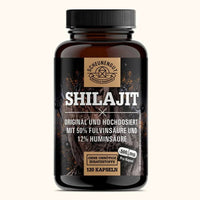
Mumijo is a mineral-rich natural resin that seeps out of rock crevices in high mountains over long periods of time. It is the same substance as shilajit — just known by different regional names. Typical components include fulvic acid, humic acid, and numerous trace elements and minerals.
Mumijo is a mineral-rich natural resin that seeps out of rock crevices in high mountain regions over very long periods of time — and it's the same substance as Shilajit: both terms describe one and the same natural substance, just under different regional names. While "Shilajit" comes from the Ayurvedic tradition of India and the Himalayas, "Mumijo" is the term more commonly used in Russia, Central Asia, and the Altai Mountains. This dark, resin-like material is characterised by its high content of fulvic acid and humic acid, along with a broad spectrum of trace elements and minerals.
Mumijo and Shilajit — Two Names, One Natural Resin
Anyone who looks into this topic quickly comes across both terms — and often the question of whether there's a difference. The clear answer: no. Mumijo (also spelled regionally as "Mumie" or "Moomiyo") and Shilajit refer to the same natural resin. It's one and the same raw material that became known under its respective common name in different cultures.
The name "Shilajit" has its roots in Sanskrit and is traditionally used in the Ayurvedic teachings of India and the Himalayan region. "Mumijo," on the other hand, is the term established in Russia, the Central Asian states, and the Siberian Altai. Both names describe the same find: a naturally formed resin from high mountain regions. So when you see "Mumijo capsules" or "Shilajit resin," we're talking about the same source material — a connection we explore in detail in our guide Shilajit, Mumijo & Fulvic Acid.
How Mumijo Forms and Where It Comes From
Mumijo isn't a laboratory product, but a work of nature that above all requires time. Over very long periods, this dark, viscous material seeps out of cracks and crevices in the rock of steep high-mountain terrain. It's classically found at high altitudes — for example in the mountain ranges of the Himalayas, the Altai, the Caucasus, and other mountain regions of Central Asia.
These deposits are typically found where extreme climatic conditions, sun exposure, and prolonged contact with the surrounding rock combine. It's precisely this origin in mineral-rich rock that explains why Mumijo carries such a characteristic spectrum of trace elements. Because the raw material comes directly from nature, it varies depending on the region of origin — which is exactly why the subsequent processing and testing are so crucial.
Fulvic Acid, Humic Acid, and Minerals
What makes Mumijo so special from a compositional point of view is exactly that: its composition. At its core are three groups of components: fulvic acid, humic acid, and a wide range of trace elements and minerals. Fulvic acid and humic acid belong to what are known as humic substances — organic compounds that form in nature over long periods as plant material breaks down.
Fulvic acid holds a special position here: its content is considered the key quality marker for Mumijo. A high fulvic acid share is a hallmark of high-quality, well-processed material. That's why reputable suppliers transparently state the fulvic acid content. Alongside these humic substances, Mumijo provides a broad range of minerals and trace elements that reflect its origin in mineral-rich high-mountain rock. If you'd like to dive deeper into the individual components and their role, you'll find more background in our guide What Shilajit Is Good For.
Traditional Use of Mumijo
Mumijo looks back on a long history of use. In the Ayurvedic tradition of India, it counts — under the name Shilajit — among the Rasayanas, a special category of traditional substances. In the folk medicine of Central Asia and Russia, in turn, Mumijo has been a fixture of traditional knowledge for generations and was valued by people in mountain regions over long periods of time.
This traditional use explains why Mumijo remains such a well-known natural substance to this day. It's important to know: here, we're describing its cultural and historical use. We deliberately don't make specific health-related claims, because within the EU this natural resin is classified as a traditional natural product rather than a remedy. The appeal of Mumijo lies in its natural origin, its provenance, and its long history.
Forms, Quality, and Purity
Mumijo is available in two main forms: as resin, and as capsules or extract. The resin is the original, concentrated form — thick, dark, and portionable. Capsules, by contrast, offer a practical, odourless and tasteless option with a fixed dose. Which form is right for you depends on personal preference; our article Shilajit as Resin or Capsules offers a direct comparison.
One point that matters especially with Mumijo is purity. Because the raw material comes directly from rock, untreated material can be contaminated with heavy metals. That's why only purified, lab-tested Mumijo should be used. Transparent lab testing and a stated fulvic acid content are the most important hallmarks of high-quality products. If you want to be on the safe side when buying, our guide what to look for when buying Shilajit offers practical guidance, and for the right way to take it, our guide on intake and dosage can help. If you'd like to go straight for tested material, we recommend our lab-tested Mumijo Shilajit with 50% fulvic acid.
Frequently Asked Questions
Is Mumijo the same as Shilajit?
Yes. Mumijo and Shilajit refer to the same mineral-rich natural resin. "Shilajit" is the Ayurvedic name from India and the Himalayas, while "Mumijo" is the term more commonly used in Russia, Central Asia, and the Altai.
Where does Mumijo come from?
Mumijo seeps out of rock crevices in high-mountain regions over very long periods of time. Classic deposits are found in the Himalayas, the Altai, the Caucasus, and other mountain ranges of Central Asia.
What does Mumijo contain?
It's characterised by fulvic acid and humic acid, along with a broad spectrum of trace elements and minerals. The fulvic acid content is considered the key quality marker.
What forms does Mumijo come in?
Mumijo is available as resin and as capsules or extract. The resin is the original, concentrated form, while capsules offer a practical option with a fixed dose.
What should you look out for with Mumijo?
Purity and lab testing. Raw material can be contaminated with heavy metals, so only purified, lab-tested material should be used. A stated fulvic acid content is an important quality marker.
Why does Mumijo have several names?
Because the same natural substance became known in different cultures. In the Ayurvedic world it's called Shilajit; in Russia and Central Asia, Mumijo (also Mumie or Moomiyo). It always refers to the same natural resin.
Health notice: This guide is for general information purposes only and does not replace individual medical or pharmaceutical advice. Food supplements are not a substitute for a balanced, varied diet and a healthy lifestyle. If you have health concerns, are pregnant or breastfeeding, or are taking medication, please consult a doctor or pharmacist. How our guides are created →