



Bilberry extract is an anthocyanin-rich concentrate from the fruits of the bilberry, often the dark wild bilberry. It is used traditionally and usually offered as a capsule. There are no authorised health-related EU claims for the extract itself, but there are for nutrients such as vitamin A, riboflavin and zinc.
Bilberry extract is obtained from the dark blue fruits of the bilberry and is rich in anthocyanins, the plant pigments that give the berry its intense colour. Bilberry extract often refers to the extract from the wild bilberry (Vaccinium myrtillus), which is used traditionally and whose berries have a particularly high anthocyanin content. This overview summarises what makes bilberry extract, which forms exist and what you can look out for regarding intake and purchase.
What is bilberry extract?
Bilberry extract is a concentrate from the fruits of the bilberry. A distinction is often made between the cultivated blueberry and the smaller wild bilberry that is dark-coloured throughout. The latter is preferred for extracts because its flesh is particularly rich in anthocyanins. These secondary plant compounds belong to the group of polyphenols.
Besides anthocyanins, bilberries contain further plant compounds, vitamins such as vitamin C as well as dietary fibre. In the extract the anthocyanins are concentrated, often standardised to a certain percentage. Bilberries and their leaves are used traditionally and have long been part of the handed-down knowledge of plants in Europe.
The wild bilberry, also called blueberry or (in German) Bickbeere, grows above all in open woodland and heathland. Its flesh, unlike that of the cultivated blueberry, is dark-coloured throughout, because the anthocyanins sit not only in the skin but also in the interior of the berry. It is precisely this high and evenly distributed anthocyanin content that makes the wild form so sought-after for extract production. Cultivated blueberries from cultivation are larger, milder in taste and easier to harvest, but often have a lighter flesh and a lower pigment content. For the extract, the stated content is therefore what counts most.
Constituents and forms
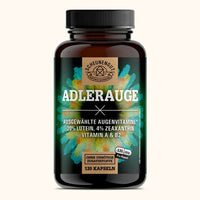
Bilberry extract is offered above all in capsules or tablets, partly also as powder or a liquid extract. Standardised preparations state the anthocyanin content, which makes it easier to compare products. Some food supplements combine bilberry extract with further ingredients such as lutein, zeaxanthin or certain vitamins. One example is our eye vitamins (Adlerauge): each capsule contains 32.5 mg of bilberry extract with 10 % anthocyanidins, plus 20 mg of lutein, 4 mg of zeaxanthin and vitamin A and vitamin B2.
Important to know: for bilberry extract and the anthocyanins it contains there are no authorised health-related claims in the EU. Statements about a specific effect on the eyes, eyesight or other bodily functions are therefore not permitted for the extract itself. Authorised claims, by contrast, exist for individual vitamins and minerals that are added to some combination products, for instance 890 µg of vitamin A and 1.4 mg of vitamin B2 per capsule in our eye vitamins.
The various forms of administration differ in practicality and transparency. Capsules and tablets are easy to dose and taste-neutral. Powder can be stirred flexibly into drinks or yoghurt; a liquid extract seems more natural to some. Standardised products that state the anthocyanin content in milligrams or percent allow the fairest comparison. With combination preparations it is worth a close look at the list of ingredients, because here the nutritionally relevant contribution often lies in the added vitamins and minerals and not in the bilberry share alone.
Intake and dosage
There is no generally valid, officially recommended dosage for bilberry extract. Manufacturers make product-dependent intake recommendations that vary according to standardisation and form of administration. You should keep to these instructions and not exceed them without good reason. Capsules are usually taken with some liquid with a meal. With our eye vitamins, it is one capsule a day with enough liquid, and the time of day is up to you. At one capsule a day, the 120 capsules in a tub last 120 days.
Anyone trying a preparation sensibly begins with the amount stated by the manufacturer and observes their own tolerability. Fundamentally: an extract is a supplement, not a necessity. Fresh or frozen bilberries also provide anthocyanins and can be incorporated straightforwardly into a varied diet.
Frozen berries are hardly inferior to fresh ones, because flash freezing preserves many of the valuable constituents well. This means bilberries can be used all year round, for example in muesli, in a smoothie or as a topping. A colourful selection of berries and other fruit also ensures a broad spectrum of plant compounds. Anyone who regularly eats berries anyway already covers part of their anthocyanin intake through their normal diet, so that an extract can be a supplement above all for people with a very berry-poor diet.
What you can look out for when buying
When buying bilberry extract it is worth a look at the origin of the berries and the standardisation. Products with a stated anthocyanin content and a traceable origin of the berries make the quality more transparent. With our eye vitamins, both details are on the product page: 10 % anthocyanidins in the bilberry extract, with the bilberries coming from fields in Sweden. A short list of ingredients without unnecessary additives is often a good sign. The eye vitamins need no additives, colourings or fillers, and every batch goes to an independent laboratory.
Make sure that advertising statements keep within the permissible framework. Exaggerated promises about eyesight or eye complaints are more of a warning signal than a quality feature. Reputable suppliers point out that food supplements are no substitute for a balanced, varied diet and a healthy lifestyle. Price alone also says little about quality. Decisive are comprehensible statements about origin, content and composition as well as a factual, non-exaggerated presentation of the product.
Nutrients around the eyes
When it comes to the eyes, certain nutrients are of importance for which there are authorised EU claims. Vitamin A contributes to the maintenance of normal vision. Riboflavin (vitamin B2) contributes to the maintenance of normal vision. Zinc contributes to the maintenance of normal vision. Riboflavin (vitamin B2) also contributes to the protection of cells from oxidative stress. These statements refer to the nutrients named, not to bilberry extract. Our eye vitamins contain 890 µg of vitamin A per capsule (111.3 % of the nutrient reference value) and 1.4 mg of vitamin B2 (100 %).
Plant compounds such as lutein and zeaxanthin occur naturally in the retina and are contained, among other things, in green leafy vegetables. For them, however, there are no authorised health-related claims. In the eye vitamins from Scheunengut they are present in high doses, with 20 mg of lutein and 4 mg of zeaxanthin per capsule from the upright marigold. A balanced diet with plenty of vegetables, fruit and wholegrain products usually provides the spectrum of these nutrients well.
Precisely with nutrients around the eyes it is worth looking at the diet as a whole rather than at a single product. Green leafy vegetables such as kale and spinach, colourful vegetables and fruit as well as high-quality fats together provide a broad spectrum of vitamins and plant compounds. Anyone who eats a varied, plant-focused diet thereby creates a solid basis. An extract or a combination preparation such as our eye vitamins supplements this basis, for example on long screen days, and belongs alongside a permanently balanced diet and a healthy lifestyle.
Safety and tolerability
For healthy adults, bilberry extract is generally regarded as well tolerated at usual consumption. As with any concentrated plant extract, individual reactions are possible. Anyone who reacts sensitively should adjust or pause the intake and keep to the stated amount of consumption. In larger amounts, bilberries and their extracts can temporarily colour the stool dark, which is harmless but can be surprising.
Pregnant and breastfeeding women, people with chronic conditions as well as persons who take medicines best consult a doctor before use, since interactions cannot be ruled out in all cases. Keep food supplements out of the reach of children. An extract can accompany a healthy diet but does not replace it.
Honestly considered
Bilberry extract is a pigment-rich plant extract with a long history of use, for which there are no authorised health-related statements. In a combination product, the nutrients with clear EU statements therefore stand next to the extract, which with the eye vitamins are vitamin A and vitamin B2. The greatest leverage remains the diet as a whole. A colourful diet rich in vegetables and fruit provides a multitude of plant compounds that complement each other in their effect and that no single extract can represent.
Especially in connection with the eyes, many promises circulate that go beyond what is proven. Reputable is anyone who stays within the permissible framework: for individual nutrients such as vitamin A, riboflavin and zinc there are clear statements on the maintenance of normal vision, for the bilberry extract itself not. Anyone who has the impression that something is wrong with their sight should have this clarified by an eye doctor and not wait. This keeps the handling of the product honest and appropriate.
Matching Products from Scheunengut
Eye vitamins (Adlerauge): The eye complex for the digital everyday with a lot of screen time. Each capsule contains 20 mg of lutein and 4 mg of zeaxanthin, the natural pigments of the macula from the upright marigold, plus 32.5 mg of bilberry extract with 10 % anthocyanidins (3.25 mg), 890 µg of vitamin A, 1.4 mg of vitamin B2 and 1.25 mg of beta-carotene. The bilberries come from fields in Sweden, and the marigold is grown and dried in Mexico. In Germany both are extracted in two steps, with steam for the water-soluble and with food-grade alcohol for the fat-soluble constituents. One capsule a day, the time of day is up to you, so 120 capsules last 120 days, 0.18 € a day according to the product page. The capsule shell is plant-based and free from carrageenan and PEG, and every batch is laboratory-tested. Vitamin A contributes to the maintenance of normal vision. Vitamin B2 contributes to the maintenance of normal vision. Vitamin B2 contributes to the protection of cells from oxidative stress.
Scheunengut has been doing all this since 2012, with no investors behind us and a focus on pure raw-material quality: clear formulas without additives, colourings or fillers, every batch tested in an independent laboratory.
Frequently asked questions (FAQ)
What is bilberry extract?
Bilberry extract is a concentrate from the fruits of the bilberry, usually the anthocyanin-rich wild bilberry. Anthocyanins are the dark plant pigments of the berry and belong to the polyphenols.
Are there authorised efficacy statements for bilberry extract?
No. For bilberry extract and the anthocyanins it contains there are no authorised health-related claims in the EU. Authorised claims exist, by contrast, for individual nutrients such as vitamin A, riboflavin and zinc.
How is bilberry extract taken?
Capsules or tablets are usually taken with some liquid with a meal. Keep to the manufacturer's intake recommendation and do not exceed it without good reason. You take our eye vitamins as one capsule a day.
Which nutrients are of importance for eyesight?
Vitamin A contributes to the maintenance of normal vision. Riboflavin (vitamin B2) contributes to the maintenance of normal vision. Zinc contributes to the maintenance of normal vision. These statements refer to the nutrients themselves, not to bilberry extract.
Is bilberry extract well tolerated?
For healthy adults, bilberry extract is generally regarded as well tolerated at usual consumption. Pregnant and breastfeeding women and people with illnesses or taking medicines should consult a doctor beforehand.
Health notice: This guide is for general information purposes only and does not replace individual medical or pharmaceutical advice. Food supplements are not a substitute for a balanced, varied diet and a healthy lifestyle. If you have health concerns, are pregnant or breastfeeding, or are taking medication, please consult a doctor or pharmacist. How our guides are created →
Sources
- Bilberries: Curative and Miraculous — A Review on Bioactive Constituents and Clinical Research — Frontiers in Pharmacology / PubMed Central (NIH), 2022
- EU Register: Anthocyanins from bilberry and blackcurrant – non-authorised eye-health claim — European Commission, 2024
- Antioxidants: Helpers Against Free Radicals — Verbraucherzentrale, 2020