



You take vitamin D3 and K2 together with one meal that contains some fat, with no gap between them. K2 isn't compulsory, but the pairing makes sense if you regularly take higher-dose vitamin D, since both work on the calcium pathway. If you take anticoagulants, talk to your doctor about K2 first.
Yes, you take vitamin D3 and K2 together: with the same meal, no gap between them. Whether it has to be K2 is a separate question, and the answer is no. We think the combination makes sense once you supplement vitamin D regularly and in higher amounts, because the two work on the same calcium pathway.
Your plan in short: both vitamins go with a meal that has some fat in it. The time of day doesn't matter. Vitamin D is stored in the body and MK-7 stays in the blood for a long time, so a fixed habit counts for more than the exact minute. You can add magnesium and omega-3 on the same day. Calcium and anticoagulants deserve a closer look. Our depot tablet brings both vitamins in one: 5,000 IU of D3 and 100 µg of K2, one tablet every five days.
Why you always find the two as a pair
Vitamin D contributes to the normal absorption/utilisation of calcium and phosphorus. Vitamin D also contributes to the maintenance of normal bones, to the maintenance of normal teeth and to the normal function of the immune system. That's the “calcium in” side.
Vitamin K sits one station further down the line. Vitamin K contributes to the maintenance of normal bones. It also contributes to normal blood clotting. Biochemically it's a cofactor, a helper in making proteins that bind calcium: osteocalcin in bone, matrix Gla protein in cartilage and the vessel wall. Without vitamin K, these proteins stay unfinished.
From this division of labour comes the idea: if you take more vitamin D, make sure you get vitamin K too. What that brings in everyday life can't be put into a clean number yet, and that's exactly where what we can back up ends. A 2025 review describes the interplay as a lively field of research and itself cautions against big promises. So we don't make any either.
Does it really have to be K2 if you take vitamin D?
No. For adults, the German Nutrition Society (DGE) gives estimated values for vitamin K of 60 to 80 µg a day, depending on age and sex. Vitamin K1 comes from plants. Menaquinones (K2) are found mainly in animal and fermented foods.
Our view: with a small daily amount of vitamin D, you don't strictly need K2. If you take a high dose, a depot form or take it for months, a combination product is convenient because you don't have to piece the two together separately. That is exactly what our Vitamin D3 Depot + K2 is for: high-dose, with the K2 already on board, no two tubs in the bathroom and no daily swallowing. Especially in the dark months, when your skin barely makes vitamin D from the sun, that is handy.
How much K2 goes with D3?
We haven't found a fixed ratio of D3 to K2 from any official body we've opened. The DGE gives only the total intake for vitamin K. So on the label, what matters most is that both amounts are listed separately and that you can see the amount and form of K2. Then you can compare the product with others, check it against your diet and, if you take medication, talk it through with your doctor. In our tablet, 5,000 IU of vitamin D3 meet 100 µg of K2Pure® (MK-7, over 99% all-trans). Both are listed separately.
For the form, look at the chain length. MK-7 is the long-chain variant. It stays in the blood much longer than the short-chain K1, its levels fluctuate little, and with long-term intake MK-7 accumulates. That was shown in a study using MK-7 from natto. The DGE also points out that how well the K forms are absorbed depends on the length of the side chain and on the fat in your food.
How to fit it into your day
Both vitamins are fat-soluble. In one study, blood levels of vitamin D3 rose higher when the meal contained fat than after a fat-free breakfast. Which type of fat it was made no measurable difference. Butter on bread, an egg, yoghurt with nuts: that's enough. A tablet with black coffee on its own brings no fat along.
Morning or evening? Doesn't matter. Pick the meal where you'll reliably remember it, and stick with it.
Our depot tablet isn't taken daily but every fifth day. On average that is 1,000 IU of D3 a day, and a tub of 180 tablets lasts 900 days. But a five-day rhythm doesn't fit any weekly routine. Put the dates in your calendar or tick them off on the pack, and put the tablet on the biggest meal of the day. The time of day doesn't matter here.
With calcium: yes, but not just in case
You can take D3 and K2 together with a calcium supplement, even with the same meal. The thinking behind it holds up. Vitamin D contributes to the normal absorption/utilisation of calcium and phosphorus. Vitamin K contributes to the maintenance of normal bones. And calcium is needed for the maintenance of normal teeth.
The catch lies elsewhere. You only need calcium from capsules if your food doesn't supply it. And the DGE writes that a permanently excessive intake of vitamin D can lead to kidney stones and calcification of the kidneys. If you combine vitamin D and a calcium supplement over a longer period, have your blood level checked beforehand and from time to time, rather than dosing by feel and hoping it works out. The product description of our tablet lists D3 and K2, but no calcium.
With magnesium: your vitamin D needs it
Here the two go hand in hand. The enzymes that convert vitamin D in the liver and kidneys appear to need magnesium as a cofactor. A 2018 review concludes that you should make sure you meet the recommended magnesium intake so that vitamin D can do its job. A randomised study found that magnesium affected vitamin D levels differently depending on where people started. More magnesium doesn't automatically mean more D.
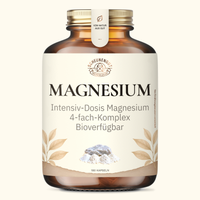
Magnesium contributes to normal muscle function, to the normal functioning of the nervous system and to the maintenance of normal bones. You can take it with your D3 meal or in the evening. It needs no fat, because magnesium is a mineral and not one of the fat-soluble vitamins. If your gut is sensitive, split the daily amount across two meals. With the depot tablet, our Magnesium Complex fits, with 400 mg of elemental magnesium per daily dose, and for a sensitive stomach the Magnesium Bisglycinate with 360 mg. How the three fit together is covered in our guide to D3, K2 and magnesium.
Omega-3, vitamin C and iron in the same plan
Omega-3 supplies fat, and fat is exactly what D3 and K2 need to be absorbed. An omega-3 capsule with the same meal is therefore an obvious solution. That's our conclusion from the fat finding above; it wasn't tested in this form.
Vitamin C dissolves in water and manages without fat. We haven't found any evidence that it clashes with D3 or K2. The same goes for iron: we haven't come across any interaction between iron and vitamin D or K. The brake on iron is calcium. If you take both, separate iron and calcium by a few hours. That belongs in your calcium plan, not with D3 or K2.
When to talk to your doctor about K2 first
This is the most important sentence here: if you take oral anticoagulants, such as the classic coumarins, agree on K2 beforehand. Vitamin K contributes to normal blood clotting and can therefore interfere with exactly this treatment. Talk to your doctor first, then take the tablet. That applies to every K2 supplement, ours included. Pregnant and breastfeeding women, children and adolescents also leave the high-dose depot out, as it says on the pack.
How to recognise a good D3-K2 supplement
Price per tablet and star ratings say little about a supplement. You check these four points on the label yourself:
- D3, not D2. Cholecalciferol is D3.
- K2 with form and amount. MK-7 and the amount in µg, not just “vitamin K”.
- Both amounts listed separately. IU or µg for D3, µg for K2.
- A short ingredient list. The fewer additives, the less there is to question.
Our Vitamin D3 Depot + K2 meets all four: cholecalciferol with 5,000 IU, K2 as K2Pure® MK-7 with 100 µg, both amounts listed separately, one plant-based tablet with a short ingredient list. There's a closer look at the K2 forms in our guide to buying vitamin K2.
Matching Products from Scheunengut
The Vitamin D3 Depot + K2 (in the shop: Vitamin D3 Depot + K2Pure®, high-dose, 5,000 IU) puts both vitamins into one tablet: 5,000 IU of vitamin D3 as cholecalciferol and 100 µg of vitamin K2 as K2Pure® (MK-7, over 99% all-trans). You take just one every fifth day, which averages 1,000 IU of D3 a day. 180 tablets therefore last 900 days, about two and a half years. The tablet is plant-based, vegan and made in Europe (DE, AT, CH +), and because raw materials and every finished batch go to an independent laboratory, you read on this tub's label what should be inside, and a lab checks that it is. That is the point.
These authorised statements apply: Vitamin D contributes to the normal absorption/utilisation of calcium and phosphorus, to the maintenance of normal bones, to the maintenance of normal muscle function and to the normal function of the immune system. Vitamin K contributes to the maintenance of normal bones and to normal blood clotting. The high-dose depot is not intended for pregnant or breastfeeding women, or for children and adolescents.
On the magnesium side we offer two forms. The Magnesium Complex brings together four magnesium sources, including citrate, malate and bisglycinate, and provides 400 mg of elemental magnesium per daily dose from two capsules. Magnesium contributes to a reduction of tiredness and fatigue and to normal muscle function, just right for long days and training evenings. The Magnesium Bisglycinate is a chelate with 360 mg of elemental magnesium a day from three capsules with meals, vegan and gentle on the stomach. We don't sell omega-3 as a single product; the fat for absorption comes from butter, an egg or yoghurt.
Behind all three stands Scheunengut: since 2012, with no investors, with a focus on pure raw-material quality and a lab report for every batch.
Frequently Asked Questions (FAQ)
Do you have to take vitamin D with K2?
No, there's no requirement. We think the combination makes sense if you take vitamin D regularly in a high dose or in depot form, because both work on the calcium pathway. With a small daily amount, your diet is often enough.
How much K2 goes with D3?
We haven't found an official ratio. The DGE gives estimated values of 60 to 80 µg of vitamin K a day for adults. Make sure the label lists D3 and K2 separately with their amounts. In our tablet that is 5,000 IU of D3 and 100 µg of K2Pure®. If you take anticoagulants, talk to your doctor first.
Can you take vitamin D3 and K2 with calcium?
Yes, even with the same meal. Vitamin D contributes to the normal absorption/utilisation of calcium and phosphorus. If you take both in high doses over a longer period, have your vitamin D blood level checked.
Can you take vitamin D3 and K2 with magnesium?
Yes. The vitamin D enzymes appear to need magnesium. You take magnesium with the same meal or in the evening, split across two meals if your gut is sensitive.
Can you take omega-3 and D3 K2 together?
Yes. Omega-3 brings fat along, and both D3 and K2 need fat to be absorbed. We haven't come across any evidence of an interaction that would call for a gap.
Can you take D3 K2 with iron or vitamin C?
We haven't found an interaction. With iron, calcium is the brake, not D3 or K2. Vitamin C dissolves in water and needs no fat.
What applies with blood thinners?
Vitamin K contributes to normal blood clotting. If you take oral anticoagulants, such as coumarins, agree on K2 with your doctor beforehand.
Health notice: This guide is for general information purposes only and does not replace individual medical or pharmaceutical advice. Food supplements are not a substitute for a balanced, varied diet and a healthy lifestyle. If you have health concerns, are pregnant or breastfeeding, or are taking medication, please consult a doctor or pharmacist. How our guides are created →
Sources
- Vitamin D – reference values — German Nutrition Society (DGE)
- Vitamin D – frequently asked questions — German Nutrition Society (DGE)
- Vitamin K – reference values — German Nutrition Society (DGE)
- Vitamin K-containing dietary supplements: comparison of synthetic vitamin K1 and natto-derived menaquinone-7 — Schurgers LJ et al., Blood, 2007
- Dietary fat increases vitamin D-3 absorption — Dawson-Hughes B et al., Journal of the Academy of Nutrition and Dietetics, 2015
- Role of Magnesium in Vitamin D Activation and Function — Uwitonze AM, Razzaque MS, Journal of the American Osteopathic Association, 2018
- Magnesium status and supplementation influence vitamin D status and metabolism — Dai Q et al., American Journal of Clinical Nutrition, 2018
- Vitamin D and Vitamin K: Synergistic Roles and Emerging Evidence for Combined Supplementation — Khandelwal A et al., 2025