



Yes – ashwagandha and magnesium combine very well in the evening. Magnesium contributes to the normal function of the nervous system and to normal psychological function, while ashwagandha is a traditional Ayurvedic adaptogen for quiet times. Ideal: a standardised ashwagandha extract plus a well-tolerated form of magnesium such as bisglycinate, taken about one to two hours before bed.
Yes, ashwagandha and magnesium combine very well in the evening. Magnesium contributes to the normal function of the nervous system and to normal psychological function – both scientifically assessed and authorised in the EU. Ashwagandha complements this as a traditional Ayurvedic adaptogen that has been used for centuries for periods of rest. Taken about one to two hours before bed, the two make a well-rounded, everyday-friendly evening routine.
What matters: the right extract quality for ashwagandha, the magnesium form that suits your stomach and a dose that suits you. That is exactly what we go through step by step now – including the official magnesium statements in their exact wording.
What ashwagandha and magnesium do in the body
Magnesium is an essential mineral. The body cannot produce it itself but depends on it: magnesium is involved in over 300 enzyme reactions. For hardly any other mineral are there so many officially assessed statements – and they are what make magnesium the backbone of any evening routine. Four of them count here:
- Magnesium contributes to the normal function of the nervous system.
- Magnesium contributes to normal psychological function.
- Magnesium contributes to the reduction of tiredness and fatigue.
- Magnesium contributes to normal muscle function.
These four statements are officially listed in the EU register of health claims and apply to magnesium as a nutrient in general. For the evening routine, the nervous system and psychological function matter most; tiredness and muscle function round out the picture. A magnesium deficiency is not the rule in Germany, but it does occur – for example with a one-sided diet, heavy sweating during sport or certain medical conditions. If your diet does not cover your needs, targeted supplementation makes sense.
Ashwagandha (Withania somnifera), also known as sleep berry or winter cherry, is one of the central medicinal plants of India's Ayurvedic tradition. The root is used. For centuries it has counted there among the adaptogens – plants that are set alongside the body in demanding phases. As a dietary supplement, a standardised root extract is usually used today, calibrated to a specific proportion of withanolides, the characteristic plant compounds of the root. This standardisation ensures comparable quality from batch to batch – and that is exactly what you should look for when buying, because the content and quality of ashwagandha products on the market vary considerably. For ashwagandha itself there is currently no authorised health claim in the EU; we therefore describe the plant on the basis of its traditional use.
Why the combination makes sense in the evening
The logic is simple: magnesium provides the officially confirmed link to the nervous system, ashwagandha the traditional role as a plant for quiet times. Both target the same time of day, but from different directions – one building block officially assessed, the other tried and tested for centuries in Ayurvedic practice. It is precisely this mix of assessed claim and traditional use that makes the evening stack so popular.
There is also an effect that is often underestimated: the ritual itself. Anyone who deliberately reaches for the capsule or powder in the evening usually ties it to a fixed routine – phone away, a glass of water, a few quiet minutes. This structure adds to the intake and makes the evening routine as a whole more effective. Ashwagandha and magnesium are thus not only two nutrients but also the occasion for a mindful close to the day.
What research is investigating
For magnesium the evidence is so clear that the four statements above have gone through the official authorisation process and are listed in the EU register – the highest standard a health claim can reach in Europe. For ashwagandha the picture is different: the plant has been used in Ayurvedic medicine for centuries, and modern research interest in standardised extracts is growing noticeably. It is a long road until a plant extract receives its own EU authorisation – at present no ashwagandha product has reached that status. That does not diminish the centuries of traditional use, but it puts it into realistic context: traditionally grounded, not yet confirmed by authorities.
Intake, dosage and timing
Here is how to put the combination into practice:
- Timing: Take both about one to two hours before bed. With higher magnesium doses it is worth splitting between morning and evening – that improves tolerability. More important than an exact time is regularity: build the intake firmly into your daily routine.
- Ashwagandha extract: Choose a standardised root extract with a stated withanolide content. Typical capsules contain 250 to 600 milligrams of extract. Our Ashwagandha KSM-66® provides 600 mg of root extract with 5 % withanolides (30 mg) per daily dose of 2 capsules, our Bio Ashwagandha as whole organic root powder 1950 mg per daily dose of 3 capsules. Follow the recommended intake and start on the lower side.
- Magnesium form: For evening use, well-tolerated organic compounds are suitable. Magnesium bisglycinate is considered particularly gentle on the stomach, and magnesium citrate is also well absorbed. Which form fits best depends on your individual tolerability. Our magnesium bisglycinate provides 360 mg of elemental magnesium per daily dose of 3 capsules; the magnesium complex combines dicitrate, oxide, malate and bisglycinate with 400 mg of elemental magnesium per daily dose of 2 capsules.
- Magnesium dosage: Adult women need around 300 milligrams per day, men 350 to 400 milligrams – part of which the diet already covers. With a sensitive gut, spread the daily amount over two meals. If stools turn soft, take less at once.
- Order: Whether ashwagandha or magnesium comes first makes no difference. Both can be taken with a little water, ideally with or after a meal – that supports tolerability further.
Consistency over several weeks is what counts. A standardised ashwagandha extract is traditionally taken as a course over a longer period, and magnesium too delivers its benefit above all when an actual need is met over weeks. A single evening dose says little – put your capsules or powder in a visible, fixed place so the routine does not lapse.
When to be careful
- Pregnancy and breastfeeding: Ashwagandha is not recommended.
- Thyroid: Caution is advised with thyroid conditions or thyroid medication.
- Medication and pre-existing conditions: This applies especially to sedatives, blood pressure or immune medication and chronic conditions.
- Kidneys: With impaired kidney function the body can excrete excess magnesium less well.
- Magnesium and gut: With soft stools, lower the amount and spread it over two meals.
In all these cases: briefly discuss the intake with your doctor. It takes five minutes and removes any risk.
Honestly put into context
The foundation for restful evenings remains sleep hygiene: regular sleep times, a cool, darkened bedroom, less screen time late in the evening and a mindful approach to caffeine and alcohol. The routine with ashwagandha and magnesium sits on that foundation.
Individual differences are large: diet, lifestyle and starting point all influence how noticeable a routine is. Give the combination several weeks before you judge, and watch your own tolerability. If the hoped-for effect fails to appear or sleep problems drag on over a longer time, it is worth looking at the causes – sleep hygiene, stress level, daily structure, and if in doubt a medical check. Pushing the amount up on your own is not a solution.
Matching Products from Scheunengut
Since 2012 we have worked without investors behind us and with a focus on pure raw-material quality: the raw materials and finished products of every batch go to independent laboratories. For the evening routine we have four products in our range.
- Ashwagandha KSM-66®: organic root extract 12:1, standardised to 5 % withanolides. That is 600 mg of extract with 30 mg of withanolides per daily dose (2 capsules), obtained without solvents and vegan because the usual milk pre-treatment of the roots is left out. In Ayurveda, ashwagandha has been valued for centuries as a root for quiet times.
- Bio Ashwagandha: finely ground organic root powder, 1950 mg per daily dose (3 capsules), vegan and free of additives apart from the plant-based capsule shell. That way the whole root is preserved.
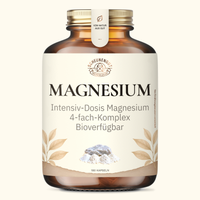
- Magnesium complex: four magnesium compounds (dicitrate, oxide, malate and bisglycinate) with 400 mg of elemental magnesium per daily dose (2 capsules), 107 % of the nutrient reference value. Magnesium contributes to the normal function of the nervous system, to normal psychological function and to the reduction of tiredness and fatigue.
- Magnesium bisglycinate: the chelate with 360 mg of elemental magnesium per daily dose (3 capsules), gentle on the stomach and vegan, free of additives, colourings and fillers and made in Europe (DE, AT, CH +). Magnesium contributes to normal muscle function.
If you also want to use melatonin in the evening, you will find it as a tablet with 1 mg per tablet and a score line. Melatonin contributes to reducing the time it takes to fall asleep. More on this in The Sleep Duo: Melatonin and Magnesium for the Evening. More forms can be found in the categories Magnesium and Ashwagandha.
Frequently Asked Questions (FAQ)
Can ashwagandha and magnesium be taken together?
Yes, there is nothing against it in principle. Ashwagandha is a traditionally used plant, magnesium an essential mineral – both can be combined in the same evening routine. Follow the respective recommended intake. If you are pregnant, have thyroid concerns, pre-existing conditions or take medication regularly, briefly discuss the combination with your doctor first.
When is the best time to take ashwagandha and magnesium?
For the evening routine, about one to two hours before bed. Regularity matters more than a fixed time. With a higher magnesium dose you can also split it between morning and evening, which often improves tolerability.
Which form of magnesium suits an evening routine?
Well-tolerated organic compounds are practical: magnesium bisglycinate is considered particularly gentle on the stomach, and magnesium citrate is also well absorbed. Our magnesium bisglycinate provides 360 mg of elemental magnesium per daily dose, the magnesium complex combines four forms with 400 mg. Which form suits you depends on tolerability and preference.
How much magnesium can I take in the evening?
That depends on your needs: women need around 300 milligrams per day, men 350 to 400 milligrams, part of which the diet covers. Our magnesium complex provides 400 mg of elemental magnesium per daily dose, the magnesium bisglycinate 360 mg. With a sensitive gut, spread the daily amount over two meals and take less at once if stools turn soft. With impaired kidney function, supplement only after consulting a doctor.
Is the combination suitable for everyone?
No. Ashwagandha is not recommended during pregnancy and breastfeeding, nor with thyroid conditions or related medication without medical advice. Anyone who regularly takes medication or has a chronic illness should clarify the intake with a doctor first.
Health notice: This guide is for general information purposes only and does not replace individual medical or pharmaceutical advice. Food supplements are not a substitute for a balanced, varied diet and a healthy lifestyle. If you have health concerns, are pregnant or breastfeeding, or are taking medication, please consult a doctor or pharmacist. How our guides are created →
Sources
- EU Register of Approved Health Claims, entries on magnesium — European Commission, 2024
- Selected Questions and Answers on Magnesium — German Federal Institute for Risk Assessment (BfR), 2021
- Reference Values for Magnesium Intake — German Nutrition Society (DGE), 2021
- Ashwagandha: What Effect Does It Have and Where Might the Risks Lie? — Verbraucherzentrale, 2026