


Natural astaxanthin is considered well tolerated in capsule amounts. Studies in healthy adults noted hardly any side effects, and there is no sign of a carcinogenic effect. Pregnant and breastfeeding women, people on blood thinners and anyone currently in cancer treatment should ask first.
No, astaxanthin is not dangerous in capsule amounts. A 2019 review went through the human studies on natural astaxanthin and found no safety problem in any of them, not even at daily amounts from 12 mg. Side effects are rare and, as a rule, harmless. And carcinogenic? We found no sign of that anywhere.
Still, some people should ask first: pregnant and breastfeeding women, parents of teenagers, anyone taking blood thinners or in the middle of cancer treatment. Why, and where the data are thin, is explained below. No sugar-coating. And no scaremongering either, because the state of the research does not support it.
What side effects does astaxanthin really have?
Hardly any. That is not a platitude but the finding from the studies in healthy adults. In one eight-week trial they took 6 mg of astaxanthin a day from a Haematococcus algae extract. Blood pressure, blood count and metabolic values stayed unremarkable. Three tiny deviations were classed by the authors as clinically meaningless.
Closer still to our capsule is a trial in young athletes. They took 12 mg a day for four weeks. Neither side effects nor stomach or gut complaints were reported. Both trials ran for weeks rather than years, though, and for almost any food supplement there are fewer data over very long periods than over short ones. That is a good reason to stick to the amount on the pack instead of doubling the capsules.
Animal studies paint a calm picture too. Rats were fed the whole astaxanthin alga for three months, at several dose levels. The researchers did not rate anything they saw as harmful.
The liver causes no problems either. In an analysis of carotenoid supplements, liver enzymes did not rise. That work looks at carotenoids as a group, not astaxanthin alone.
A personal sensitivity can never be ruled out, not even with good studies. If your stomach is sensitive, take the capsule after a meal. Our product's recommended use says the same.
Is astaxanthin carcinogenic?
No. As far as we have read, there is no evidence of it. Two things clearly speak against it: the review found no safety concerns in humans, and the rat studies showed no harmful changes in tissue examination after 90 days. That is not a cancer test in the strict sense, though.
To be honest about this as well: we have not found a decades-long study that asks specifically about cancer. Where astaxanthin appears in cancer research, it is about cell cultures and animals. A 2026 review on diseases of the mouth and throat states itself that almost all findings are preclinical and that human studies, including on safety, are still to come. We draw no benefit from that. No risk either.
Does astaxanthin discolour the skin?
In principle that is possible with carotenoids, but it has not been shown for astaxanthin. Anyone who takes in very large amounts of carotenoids over a long time can develop yellow-orange skin, especially on the palms, the soles of the feet and beside the nose. The medical term is carotenoderma, and it is considered harmless. It has been described, for example, after excessive intake of lycopene-rich vegetables and fruit.
For astaxanthin in capsule amounts we found no documented case. Keep a rule of thumb in mind: carotenoid colouring shows on the palms, not in the eyes. If the whites of your eyes turn yellow, that is something else and belongs with a doctor.
Natural or synthetic: why the source is part of the safety question
Astaxanthin comes in two versions. One comes from the alga Haematococcus pluvialis, the other is made chemically. The two are not built identically, and the review draws a clear conclusion from that: safety data on natural astaxanthin cannot be transferred to the synthetic form. There are far fewer human studies on the synthetic one.
For you that means: reach for products that name the alga in the ingredients list. Everything we describe here as well tolerated refers to this natural form, not to the synthetic one. How to recognise such a product is covered in the guide to buying astaxanthin.
How much astaxanthin a day is tolerable?
There is no fixed upper limit that we could calculate for you. There are studies in healthy adults, and they range from 6 mg to 12 mg a day and above. Many of them were at 12 mg or higher, with no safety concerns arising.
Our capsule contains 12 mg. The recommended use is one capsule every other day, so 6 mg a day on average. That is the amount from the eight-week trial. The studies mostly run for weeks in healthy adults, and what we write here applies to exactly this group. People with existing conditions or long-term medication should agree the amount with their doctor's practice or pharmacy first, even if the capsule looks harmless. Anyone who wants to dose differently should discuss it beforehand with a doctor or pharmacist. You can read more on the daily amount in the dedicated guide.
Interactions: blood thinners, surgery, cancer treatment
The most interesting lead concerns blood clotting. In lab experiments with human platelets and in animal studies, astaxanthin slowed platelets from clumping together. In one animal study the bleeding time grew longer, in another there was no excessive bleeding. Whether this matters in humans at capsule amounts has not been studied.
That is why this applies: if you take medication to thin the blood or are having an operation in the next few weeks, ask your doctor or pharmacist first. The same goes if you combine several supplements. An overview of supplements and bleeding risk lists omega-3, garlic, ginkgo, ginger and curcumin alongside astaxanthin.
The second point is cancer treatment. Antioxidants as a group are suspected of impairing tumour control during chemotherapy or radiotherapy at the same time. The findings are inconsistent, and there is no firm verdict. On astaxanthin alone we found nothing of our own. Anyone undergoing treatment should clear every food supplement with their care team first.
For all other medications there are no reliable data. If you take something regularly, ask at the pharmacy. It takes two minutes.
Pregnancy, breastfeeding, children: who should leave it alone
Pregnancy and breastfeeding: data are missing. We have not found studies on safety in pregnant or breastfeeding women. Without data, we give no advice on taking it. If you are pregnant, breastfeeding or trying to conceive, your OB-GYN or midwife decides, not a guide.
Children and teenagers: in 2025 EFSA assessed algal meal from Haematococcus as an ingredient for milk substitute products and tied this explicitly to a condition. Children and teenagers should not take any astaxanthin supplements on the same day. Astaxanthin capsules are therefore not for them.
And one more matter of course: anyone who reacts allergically to algae or to a component of the capsule should leave it.
And what about personal experiences? What can be shown
Experience reports online are single voices. We do not invent any here and we do not quote any. The state of the studies is more reliable, and we described it above: good tolerability, unremarkable blood values and unremarkable blood pressure in healthy adults.
If you want to try it yourself, here is how: take the amount on the pack, after a meal, and stay with it for a few weeks. If stomach complaints, a skin rash or anything else unusual appears, stop and ask. That is the whole plan.
Matching Products from Scheunengut
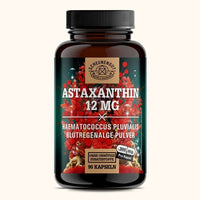
Our astaxanthin contains 12 mg per capsule, obtained from Haematococcus pluvialis in France, vegan. The ingredients list is short: Haematococcus pluvialis algal powder with 2% astaxanthin and a plant-based capsule shell made of hydroxypropyl methylcellulose. The recommended use is one capsule every other day, which equals 6 mg a day. The pack holds 120 capsules, and at this intake they last 240 days.
We have the raw materials and finished products of every batch tested for purity and content in independent laboratories. You can find the current lab report on the product page.
Frequently Asked Questions (FAQ)
What side effects does astaxanthin have and is it dangerous?
Going by the data, natural astaxanthin is not dangerous in capsule amounts. A review found no safety problem in 87 human studies. Side effects were hardly an issue in the studies. If your stomach is sensitive, take the capsule after a meal, as it also says on our pack.
Is astaxanthin carcinogenic?
No, there is no evidence of it. The rat studies showed no harmful tissue changes, and nothing stood out in humans. We have not found a decades-long study that asks specifically about cancer, though.
Can astaxanthin discolour the skin?
With a very high intake of carotenoids the skin can turn yellow-orange, especially on the palms. That is harmless. For astaxanthin in capsule amounts we found no documented case. If the whites of your eyes turn yellow, see a doctor.
What interactions does astaxanthin have?
Blood clotting is the relevant point: in the lab and in animal studies, astaxanthin slowed platelets. If you take blood thinners or are having surgery soon, ask first. During chemotherapy or radiotherapy, clear any antioxidant with your care team. For other medications, data are missing.
Can you take astaxanthin during pregnancy?
Data are missing. We have found no study on safety in pregnant or breastfeeding women and therefore give no advice on taking it. Ask your OB-GYN or midwife.
How much astaxanthin a day is tolerable?
In the studies in healthy adults, daily amounts ranged from 6 mg to 12 mg and above, with no safety concerns. Our pack says: one capsule with 12 mg every other day, 6 mg a day on average.
What are people's experiences with astaxanthin?
Single experience reports prove little. The state of the studies is what holds up: in healthy adults, blood values and blood pressure stayed unremarkable, and in young athletes no side effects were reported over four weeks.
Health notice: This guide is for general information purposes only and does not replace individual medical or pharmaceutical advice. Food supplements are not a substitute for a balanced, varied diet and a healthy lifestyle. If you have health concerns, are pregnant or breastfeeding, or are taking medication, please consult a doctor or pharmacist. How our guides are created →
Sources
- Astaxanthin: How much is too much? A safety review — Brendler T, Williamson EM · Phytotherapy Research, 2019
- Safety of an astaxanthin-rich Haematococcus pluvialis algal extract: a randomized clinical trial — Spiller GA, Dewell A · Journal of Medicinal Food, 2003
- Safety assessment of astaxanthin-rich microalgae biomass: Acute and subchronic toxicity studies in rats — Stewart JS et al. · Food and Chemical Toxicology, 2008
- Effects of 4-week astaxanthin supplementation on athletic performance and body composition in young male taekwondo athletes — Zhang XC et al. · Frontiers in Nutrition, 2025
- Effects of carotenoid supplementation on liver enzymes in adults: a systematic review and dose-response meta-analysis — Heydari SS et al. · BMC Complementary Medicine and Therapies, 2025
- Carotenoderma due to lycopenemia: a case report and evaluation of lycopene deposition in the skin — Tanaka A et al. · Journal of Dermatology, 2022
- Decoding Hypercarotenemia: Integrating Pathophysiology, Clinical Recognition, and Precision Management — Wang Z et al. · Cureus, 2025
- Astaxanthin suppresses thrombosis by inhibiting both platelet activation and blood coagulation — Zhang L et al. · British Journal of Pharmacology, 2026
- Astaxanthin inhibits platelet-mediated thrombosis via suppression of bidirectional αIIbβ3 signaling — Choi H et al. · European Journal of Pharmacology, 2026
- Navigating the Effects of Anti-Atherosclerotic Supplements and Acknowledging Associated Bleeding Risks — Dobre MZ et al. · International Journal of Molecular Sciences, 2025
- The influence of antioxidant supplementation on adverse effects and tumor interaction during radiotherapy: a systematic review — Limbrunner J et al. · Clinical and Experimental Medicine, 2025
- Lessons From Astaxanthin Therapy to Combat Oral Premalignant and Malignant Lesions: A Narrative Review — Arefnezhad R et al. · Health Science Reports, 2026
- Safety of algal meal from Haematococcus pluvialis containing astaxanthin as a novel food pursuant to Regulation (EU) 2015/2283 — EFSA Panel on Nutrition, Novel Foods and Food Allergens · EFSA Journal, 2025