



Yes, you can take magnesium and vitamin B12 together. They use different absorption routes in the gut, and no interaction is known. In practice: B12 in the morning, magnesium with breakfast or after dinner, larger magnesium amounts split into two portions. No guideline prescribes a fixed time of day.
Yes, you can take magnesium and vitamin B12 together, with the same glass of water and in the same minute. They don't get in each other's way. That's not a given with minerals: for iron and zinc, for example, people have argued for years about leaving a gap between doses, because the two compete for the same uptake routes. B12 and magnesium simply keep out of each other's path.
This guide is about B12 on its own, the single vitamin. If you're after the full set of eight B vitamins plus magnesium, the guide “B Complex & Magnesium: Combining Them Sensibly” covers that.
Why magnesium and B12 don't get in each other's way
It comes down to absorption. B12 is a bulky molecule. The B12 in food first has to detach from protein in the stomach, then binds to a carrier protein called intrinsic factor and crosses into the blood far down the small intestine. That route handles only a few micrograms per meal. Anything above that gets in passively, roughly one per cent of what you swallow.
Magnesium is a small, charged mineral and takes a different path through the gut wall, mostly in the small intestine. Two substances, two doors. Neither blocks the other, so there's no need to keep two hours apart.
Where things genuinely clash is medication. Acid blockers reduce B12 uptake from food and, after years of use, can also push magnesium levels down. Metformin is on the B12 list too. The conflict then sits with the drug, not between the two supplements. If you take these medicines long term, talk through both nutrients with your doctor.
What magnesium and B12 each contribute
Magnesium contributes to normal muscle function. Magnesium contributes to normal functioning of the nervous system. Add to that its contribution to normal energy-yielding metabolism and to the maintenance of normal bones. Magnesium also contributes to the reduction of tiredness and fatigue.
Vitamin B12 contributes to normal red blood cell formation. Vitamin B12 contributes to normal functioning of the nervous system and to normal energy-yielding metabolism. It has a role in the process of cell division and contributes to the normal function of the immune system. Vitamin B12 also contributes to the reduction of tiredness and fatigue.
You can see the overlap: nervous system, energy metabolism, tiredness. That doesn't double the effect, because the body doesn't add things up that way. The two work at different points in the same machinery. Cells use energy as ATP, and ATP exists in the body as a magnesium complex. B12 acts as a co-factor in the pathways behind blood formation and cell division.
How to spread both across your day
The easy version: everything at breakfast. B12 and magnesium together, with a slice of bread or a yoghurt. It works because B12, as a water-soluble vitamin, is absorbed with or without food, and magnesium is usually better tolerated on a full stomach. Capsules next to the coffee machine are harder to forget. For us that means one capsule of Vitamin B Complex with breakfast, with 51 micrograms of B12 in it.
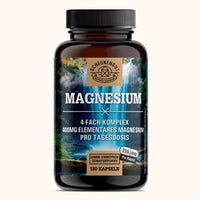
The split version: B12 in the morning, magnesium after dinner. This pays off with larger amounts of magnesium, and most of all if you wind down in the evening anyway and can build the dose into your routine. Your gut has a say, and with two portions it usually agrees. Our Magnesium Complex supplies 400 milligrams of elemental magnesium in two capsules: one with breakfast, one after dinner. If you still get loose stools, cut the amount back.
No guideline prescribes a fixed time for B12, because as a water-soluble vitamin it reaches the gut at any hour. Many people pick the morning because it's easy to tie to an existing habit. If an evening dose leaves you sleeping worse, move it forward. That's all there is to it.
Lozenges, drops and sprays with B12 dissolve in your mouth; capsules go down with water. Consistency beats any clock time. Three weeks of daily doses beat three perfectly timed days.
Methylcobalamin, bisglycinate, citrate: which forms are fine
B12 comes in four common forms: cyano-, methyl-, adenosyl- and hydroxocobalamin. All of them supply vitamin B12. Methylcobalamin and adenosylcobalamin are the coenzyme forms, the ones the body itself uses; cyanocobalamin is the best-studied and most stable. For your supply, the choice matters less than some ad copy suggests. The amount matters more, and it looks absurd at first: the DGE puts the requirement at around 4 micrograms a day, yet packs often say 500 or 1,000. That's the passive route at work. Of 1,000 micrograms, roughly 10 arrive; the rest passes through unused. Our Vitamin B Complex therefore relies on amount and form at once: high-dose, with 51 micrograms of B12 per capsule, and in three forms at that: methylcobalamin, adenosylcobalamin and hydroxocobalamin.
With magnesium, the compound decides tolerance and solubility. Magnesium oxide packs a lot of magnesium into each capsule but dissolves poorly. Citrate and malate dissolve well, though citrate acts as a laxative at high doses. Bisglycinate is bound to the amino acid glycine and is considered especially gentle on the stomach. On the label, look for the figure after “elemental magnesium”, not the weight of the compound. The compound's weight is always higher because the citrate, glycine or malate is weighed in too, which is exactly why a capsule with “1,000 mg magnesium citrate” delivers far less than 1,000 mg of magnesium. On our Magnesium Complex the figure that counts is on the label: 400 milligrams of elemental magnesium per daily dose, 107 per cent of the nutrient reference value. Four forms share the work. Citrate and malate dissolve well, bisglycinate is gentle on the stomach, and the oxide from the Dead Sea brings plenty of magnesium per capsule.
All forms can be combined freely. None of them interferes with another.
Who typically takes both
People who live vegan. B12 is found almost only in animal foods, and the DGE explicitly advises vegans to supplement. Magnesium joins in when nuts and wholegrains don't make it onto the plate in sufficient amounts every day. Our Vitamin B Complex is vegan, and even the capsule shell is plant-based.
Regular exercisers. Magnesium contributes to normal muscle function, and if you train three to five times a week, your legs come to mind first. B12 comes along because it contributes to normal red blood cell formation.
On the go, shift work, exam season. If you eat irregularly or grab breakfast between two trains, your plate has more gaps than your calendar. Both single supplements fit in any jacket pocket, and both work without a set meal.
From 60. In many people stomach acid declines with age, and B12 from food comes loose from protein less readily. B12 from a supplement is already free and sidesteps the problem.
People on acid blockers or metformin. Keep an eye on both nutrients, ideally together with the practice that knows your medication.
How much is too much?
Magnesium: The reference figure for daily requirement is 350 milligrams for men and 300 for women. With healthy kidneys you can't overdose on magnesium from ordinary food. With supplements, loose stools are the first signal: lower the amount or split it into two portions. With reduced kidney function, the dose belongs in a doctor's hands.
Vitamin B12: No upper limit has been set for B12, and the liver stores reserves for years. Still, more than you need achieves nothing, since the body absorbs only a small percentage of large doses and excretes the rest. Occasionally people report skin reactions at very high doses. If that happens, lower the dose.
The most common mistake has little to do with the dose of one supplement and everything to do with the sum. A B complex contains B12. A sleep complex with melatonin may contain magnesium. An electrolyte complex certainly does. Add up the labels before you bring in another product.
What to check when buying: four lines on the label
First, the amount per daily dose, not per 100 grams and not per capsule if the directions say two or three capsules a day, which makes the figure on the front look smaller than it ends up. Second, for magnesium, the elemental share. Third, the form: bisglycinate, citrate and malate are standard, while a blend of several sources spreads the properties. Fourth, the ingredient list. The shorter the list after the active ingredient, the better. You don't need fillers, colourings or flow agents in a capsule.
A fifth point that hardly any comparison site covers: the lab report. At Scheunengut it comes with every product, because every batch is tested for purity and content. Comparison lists usually sort by price per capsule and stars, even though amount, form and purity decide what you actually absorb.
Matching Products from Scheunengut
Scheunengut has been around since 2012, without investors and with one focus: pure raw-material quality. Every batch goes to an independent lab. The current lab report is attached as a file to every product page. For your magnesium and B12 pair, that means:
B12 comes in our Vitamin B Complex; we don't offer it as a single capsule. What you get instead is all eight B vitamins in bioactive form plus myo-inositol, betaine and choline, with B12 at 51 micrograms per capsule (2,040 per cent of the nutrient reference value) in three forms: methylcobalamin, adenosylcobalamin, hydroxocobalamin. One capsule in the morning, nothing more. At one capsule a day, the tub of 180 capsules lasts half a year. Vegan, made in Germany, free of additives, colourings and fillers. Vitamin B12 contributes to normal red blood cell formation and to the normal function of the nervous system, and it also contributes to normal psychological function. Made for vegans, for long shifts and for weeks when more energy goes out than comes in.
For magnesium we have two routes. The Magnesium Complex supplies 400 milligrams of elemental magnesium per daily dose from four sources (citrate, malate, bisglycinate and oxide), two capsules a day, and the tub of 180 capsules lasts 90 days. The Magnesium Bisglycinate supplies 360 milligrams of elemental magnesium from three capsules of 120 milligrams each, chelated, vegan and gentle on the stomach, to be taken with meals. With 240 capsules it lasts 80 days. Magnesium contributes to normal muscle function. Magnesium contributes to normal energy-yielding metabolism and to the reduction of tiredness and fatigue. That suits athletes, stressful phases and a calm evening.
Together they make a daily plan for your jacket pocket. B complex in the morning. Magnesium with breakfast or after dinner, depending on when things quieten down for you and how your gut takes to the amount.
Frequently Asked Questions (FAQ)
Can you take magnesium and vitamin B12 together?
Yes. They use different absorption routes in the gut, and no mutual interaction is known. You can take them with the same meal or spread them across the day, whichever suits your routine.
When is the best time to take magnesium and B12?
Whenever you won't forget. B12 in the morning and magnesium with breakfast or after dinner has proved a good pattern. Spread larger amounts of magnesium over two portions to keep your gut calm.
Do I have to take B12 and magnesium with food?
B12 works with or without food. Magnesium is often better tolerated on a full stomach, especially as citrate or oxide. For the bisglycinate, our label says explicitly: take with meals.
Can I take B12 from a B complex plus magnesium on top?
Yes, that works without problems. A B complex already contains B12, so a second B12 supplement is usually unnecessary. Magnesium comes in as a separate product, since a B complex contains none.
Do I need both as a vegan?
B12, yes: the DGE advises vegans to supplement, because the vitamin is found almost exclusively in animal foods. Magnesium, not automatically. Nuts, seeds, wholegrains and legumes supply plenty. A supplement makes sense if your daily intake from food falls below the reference values.
Is there a test winner for magnesium and B12?
We have no test seal and don't claim one. Comparison lists mostly rate price per capsule and stars. Elemental amount, form, ingredient list and lab report tell you more.
How much magnesium and B12 per day makes sense?
For magnesium, 300 to 350 milligrams a day is the reference figure for requirement. Supplements often supply more, for example 360 or 400 milligrams of elemental magnesium per daily dose, best split into two portions. The B12 requirement is around 4 micrograms; supplements usually contain more because only a small share arrives passively. Our Vitamin B Complex has 51 micrograms per capsule.
Health notice: This guide is for general information purposes only and does not replace individual medical or pharmaceutical advice. Food supplements are not a substitute for a balanced, varied diet and a healthy lifestyle. If you have health concerns, are pregnant or breastfeeding, or are taking medication, please consult a doctor or pharmacist. How our guides are created →
Sources
- Magnesium – Health Professional Fact Sheet — NIH Office of Dietary Supplements, 2022
- Vitamin B12 – Health Professional Fact Sheet — NIH Office of Dietary Supplements, 2025
- Vitamin B12 (Cobalamin) – Reference Values — German Nutrition Society (DGE), 2019
- Magnesium – Reference Values — German Nutrition Society (DGE), 2024
- Selected Questions and Answers on Vitamin B12 — German Nutrition Society (DGE)
- Updated Proposals for Maximum Levels of Vitamins and Minerals in Food Supplements and Fortified Foods — German Federal Institute for Risk Assessment (BfR), 2024