



No nutrient repairs a spinal disc. Calcium and vitamin D contribute to the maintenance of normal bones, manganese contributes to normal connective tissue formation, and vitamin C contributes to normal collagen formation for the normal function of cartilage and bones. The strongest lever remains exercise.
In short: no nutrient “repairs” a spinal disc, but several have approved claims for the structures around the spine. Calcium and vitamin D contribute to the maintenance of normal bones. Vitamin K, magnesium and manganese carry this approved claim as well. Manganese contributes to normal connective tissue formation, and copper contributes to the maintenance of normal connective tissue. Vitamin C contributes to normal collagen formation for the normal function of cartilage and bones. The strongest lever for a resilient back, however, remains exercise. Symptoms should always be clarified by a doctor.
The back tends to make itself known at the worst possible moment – getting up from the office chair, lifting a crate of drinks. The spine is a masterpiece made up of 33 vertebrae, 23 spinal discs, dozens of ligaments and tendons, and an entire team of muscles that keeps the whole thing upright. Each of these structures has its own nutrient needs. So instead of a “miracle disc cure,” we're taking a look at which building blocks the body needs for bones, cartilage, connective tissue, and muscles – and which of these are backed by solid EU claims.
How the Spine Is Built – and What Nourishes It
The vertebral bodies are bone. Between them sit the spinal discs, each with a tough outer fibrous ring and a gel-like core that acts as a shock absorber. Ligaments hold everything in tension, tendons connect muscles to bone, and the core muscles provide stability. Interestingly, spinal discs have almost no blood vessels of their own – they're “pumped” via movement and supplied with nutrients and fluid that way. That's one reason why exercise is so central. Different nutrients are relevant for the individual structures, and this is explicitly about the maintenance of normal structures, not treatment.
Why This Topic Concerns So Many People
Back problems are among the most common reasons people change their daily routines. There are solid reasons for this: on average, we sit for many hours a day – in the car, at the desk, on the sofa. Lack of movement and one-sided posture are poison for structures that are actually designed for varying loads. No wonder, then, that many people look for ways to support their back. The instinct to reach for supplements first is understandable – but the most honest advice is: nutrients are a sensible building block, but the lever with the greatest effect is, and remains, exercise. You should therefore read this guide as “both together,” not as “capsule instead of exercise.”
If you sit at a screen all day, for example, the biggest lever is to stand up every hour and train your core twice a week. In parallel, good nutrient supply ensures that bones, connective tissue, and muscles have the material they need for their normal functions.
Vitamin C and Collagen: The Connective Tissue Topic
Collagen is the structural protein in cartilage, ligaments, tendons, and bone – everywhere tensile strength is needed. Vitamin C is part of it, because the enzymes responsible require it as a co-factor. Approved claim: vitamin C contributes to normal collagen formation for the normal function of cartilage and bones. The same claim exists for the skin, the blood vessels and the gums. This makes it an obvious nutrient for everything related to the spine. Good sources: bell peppers, berries, citrus fruits, rosehip.
As a capsule, vitamin C is in our Glucosamine & Chondroitin: 80 mg per daily dose, which is 100% of the nutrient reference value, plus 1,350 mg of glucosamine sulphate and 1,200 mg of chondroitin sulphate in three capsules.
Bones: The Team of Calcium, Vitamin D, K, Magnesium, and Manganese
The vertebral bodies are living bone tissue that's constantly being remodeled. Five nutrients have approved claims for this, each given here in its official wording:
| Nutrient | Approved Claim |
|---|---|
| Calcium | contributes to the maintenance of normal bones; contributes to normal muscle function. |
| Vitamin D | contributes to the maintenance of normal bones; contributes to the maintenance of normal muscle function; contributes to the normal absorption and utilisation of calcium and phosphorus. |
| Vitamin K | contributes to the maintenance of normal bones. |
| Magnesium | contributes to the maintenance of normal bones; contributes to normal muscle function. |
| Manganese | contributes to the maintenance of normal bones; contributes to normal connective tissue formation. |
Especially practical: vitamin D contributes to the normal absorption and utilisation of calcium and phosphorus. Calcium and vitamin D therefore work hand in hand. If you'd like to combine both, you can look at the details in Calcium & Vitamin D Together.
Muscles: The Underrated Back Protection
If one factor determines a resilient back, it's strong core and back muscles – they take load off the vertebrae and discs. Magnesium and calcium contribute to normal muscle function. Vitamin D contributes to the maintenance of normal muscle function. Magnesium additionally contributes to the normal functioning of the nervous system and to the reduction of tiredness and fatigue. But honestly: nutrients don't build muscle. That stimulus comes from training. Nutrients are the material; exercise is the build order.
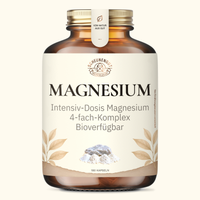
For the material, we have two routes: the Magnesium Complex with 400 mg of elemental magnesium from four sources in two capsules, or the Magnesium Bisglycinate with 360 mg in three capsules if your stomach reacts sensitively.
Connective Tissue: Manganese and Copper
Both are trace elements that the body only needs in small amounts and that play a role in forming connective tissue structures. There are two specific claims for them: manganese contributes to normal connective tissue formation, and copper contributes to the maintenance of normal connective tissue. A balanced diet with whole grains, nuts, and legumes usually covers them well.
What Research Is Looking Into
The role of calcium and vitamin D in bone metabolism and the importance of vitamin C for collagen synthesis are well-established textbook knowledge. Active research is looking into how strongly exercise and mechanical load steer disc nutrition and bone remodeling – much evidence suggests that load stimuli are a central factor here. Around collagen as a supplement, research is investigating possible effects on connective tissue structures; the picture here is not yet conclusive. What remains certain: without the building blocks mentioned, the normal processes don't function – but an excess replaces neither exercise nor medical treatment.
Food Sources for Back Nutrients
| Nutrient | Good Food Sources |
|---|---|
| Vitamin C | Bell peppers, berries, citrus fruits, rosehip, broccoli |
| Calcium | Dairy products, green vegetables, calcium-rich mineral water |
| Magnesium | Whole grains, nuts, legumes, dark chocolate |
| Vitamin K | Kale, spinach, broccoli |
| Manganese / copper | Whole grains, nuts, legumes, oats |
Vitamin D plays a special role: the body forms it mainly through sunlight, and it's only available to a limited extent through food (oily fish, eggs). Supply is therefore a particular topic in winter – individual needs can be determined via a blood test (25-OH vitamin D), ideally with medical guidance.
If you go by your blood level, the Vitamin D3 Depot + K2Pure® is a fitting form: 5,000 IU of vitamin D3 plus 100 µg of vitamin K2 in one tablet that you take only every 5th day. Vitamin D contributes to the maintenance of normal bones, and vitamin K contributes to the maintenance of normal bones.
In Practice: Exercise, Daily Life, and Sensible Supplementation
The most effective “back booster” costs nothing: regular exercise. It nourishes the discs, strengthens the supporting muscles, and keeps joints supple. In everyday life, the following has proven effective:
- Sit dynamically and stand up often: If you work in an office, you should regularly change your sitting position and stand up several times an hour – your discs will “thank” you with better nourishment.
- Strengthen your core specifically: Two to three short strength sessions per week for the abdomen and back build the muscle that nutrients alone cannot build.
- Supplement as needed: For vitamin D, it's worth checking your blood level during the months with less sunshine; magnesium can be taken well in the evening. Which form of magnesium suits you depends on tolerability – glycinate is considered especially gentle on the stomach.
- Collagen as a building material: If you're interested in collagen, you'll find a neutral assessment in Collagen: Effects, Forms & Peptides; combining it with vitamin C is a natural choice, since vitamin C is involved in the body's own collagen formation.
Supplements build on a foundation: exercise, a balanced diet, and – for any symptoms – medical assessment. On top of that, the nutrients supply the material.
Honestly Assessed: Exercise Beats Pills
Nutrients supply building blocks so that bones, connective tissue, and muscles function normally. On top come exercise, back-friendly posture, ergonomic work habits, and – for symptoms – physiotherapy and medical treatment. A herniated disc, persistent pain, or pain radiating into the arms or legs is a clear case for the doctor's office, not a matter for self-treatment. For back problems, the rule always applies: consult a doctor.
Matching Products from Scheunengut
The Glucosamine & Chondroitin, optimised with vitamin C combines, in three capsules a day, 1,350 mg of D-glucosamine sulphate and 1,200 mg of chondroitin sulphate with 80 mg of vitamin C (100% of the nutrient reference value). Vitamin C contributes to normal collagen formation for the normal function of cartilage and bones. We source the raw materials from certified manufacturers, and it is made in Europe (DE, AT, CH +). Good to know: the glucosamine sulphate comes from crustaceans, the chondroitin sulphate from beef.
For magnesium there are two routes. The Magnesium Complex combines four sources of magnesium: tri-magnesium dicitrate, magnesium oxide, magnesium malate and magnesium bisglycinate. Two capsules deliver 400 mg of elemental magnesium, to be taken at any time of day. The Magnesium Bisglycinate relies on a single form, chelated, vegan and particularly gentle on the stomach: three capsules deliver 360 mg of elemental magnesium, to be taken with meals. Magnesium contributes to normal muscle function, and magnesium contributes to the maintenance of normal bones.
For the bone side there is the Vitamin D3 Depot + K2Pure®. One tablet contains 5,000 IU of vitamin D3 (125 µg) and 100 µg of vitamin K2 (MK-7), high-dose, one tablet every 5th day. A tub of 180 tablets therefore lasts 900 days. Vitamin D contributes to the maintenance of normal bones, and vitamin K contributes to the maintenance of normal bones. Vitamin D also contributes to the maintenance of normal muscle function. The high-dose depot is not suitable for pregnant or breastfeeding women, or for children and teenagers.
Scheunengut has been around since 2012, without investors and with a focus on pure raw-material quality. All four products are made in Europe (DE, AT, CH +), and we have raw materials as well as every finished batch tested in independent labs.
You'll find more choice in our Vitamin C, Magnesium, Joints & Bones and Minerals ranges. You can read on in Nutrients for Connective Tissue, Nutrients for Bones, Nutrients for Muscles, Nutrients for Tendons & Ligaments, Vitamin C: Effects & Daily Requirement, and Type 2 Collagen for Joints.
Frequently Asked Questions (FAQ)
Which nutrients are relevant for the back and spinal discs?
Calcium and vitamin D contribute to the maintenance of normal bones. Vitamin K, magnesium and manganese carry this approved claim as well. Manganese contributes to normal connective tissue formation, and copper contributes to the maintenance of normal connective tissue. Magnesium and calcium contribute to normal muscle function, and vitamin D contributes to the maintenance of normal muscle function. Vitamin C contributes to normal collagen formation for the normal function of cartilage and bones. No nutrient repairs a spinal disc.
Can supplements treat a herniated disc?
No. A herniated disc must be clarified and treated by a doctor. Nutrients can supply building blocks for maintaining normal structures, but they don't replace diagnosis, physiotherapy, or medical treatment.
What helps the back more – nutrients or exercise?
Exercise is the strongest lever. Strong core muscles take load off the spine, and movement nourishes the discs. Nutrients supply the material for bones, connective tissue, and muscles, while the training stimulus comes from you.
Why is vitamin D especially relevant for the back in winter?
The body forms vitamin D mainly through sunlight, which is lacking in winter. Vitamin D contributes to the maintenance of normal bones. Vitamin D also contributes to the maintenance of normal muscle function and to the normal absorption and utilisation of calcium and phosphorus. The best way to determine your individual needs is via a blood test, with medical guidance.
Which form of magnesium suits the back?
That depends on how well you tolerate it. The magnesium bisglycinate is chelated and particularly gentle on the stomach, three capsules deliver 360 mg of elemental magnesium. Our Magnesium Complex combines four forms, two capsules deliver 400 mg. Magnesium contributes to normal muscle function.
Health notice: This guide is for general information purposes only and does not replace individual medical or pharmaceutical advice. Food supplements are not a substitute for a balanced, varied diet and a healthy lifestyle. If you have health concerns, are pregnant or breastfeeding, or are taking medication, please consult a doctor or pharmacist. How our guides are created →
Sources
- Food Supplements – Yes or No? — Verbraucherzentrale
- Health assessment of food supplements — German Federal Institute for Risk Assessment (BfR)
- Colorful Pills for a Clear Conscience – What Do Food Supplements Actually Do? — German Nutrition Society (DGE)
- Food supplements — European Food Safety Authority (EFSA)