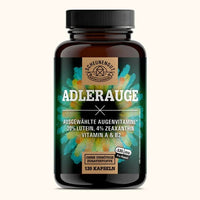
Vitamin A, riboflavin (B2), and zinc contribute to the maintenance of normal vision; the omega-3 fatty acid DHA does the same at an intake of 250 mg per day. There's no approved claim for the retinal pigments lutein and zeaxanthin. The most effective levers for screen work are regular breaks, conscious blinking, and the right viewing distance.
The short answer: Vitamin A, riboflavin (B2) and zinc contribute to the maintenance of normal vision; the omega-3 fatty acid DHA does so at an intake of 250 mg per day. For the retinal pigments lutein and zeaxanthin, by contrast, there is no authorised claim. The most effective levers when working at a screen, however, are good habits: breaks, conscious blinking, the right distance.
Do you know that feeling around 5 p.m.? Your eyes sting slightly, the image looks a touch blurry, and you rub your eyelids. After eight hours at the monitor this is surprisingly common - and as a rule harmless. Even so, it's worth understanding what is actually happening and what role nutrition plays in it (and what it doesn't).
Why the screen puts strain on your eyes
When you look at the monitor, the small muscles in the eye work continuously at close range to focus. Normally you constantly switch between near and far - and every glance into the distance is a tiny recovery break for these muscles. At the desk this switching largely disappears.
On top of this comes a second, underestimated effect: focused on the screen, your blink rate drops noticeably - from around 15 to 20 blinks per minute to sometimes half that. Every blink spreads the tear film freshly over the eye. If you blink less often, this film evaporates faster, and the eyes feel dry, irritated and tired. Experts sometimes group such complaints together as "digital eye strain". Uncomfortable, but usually no cause for concern - and importantly: nutrients support the normal function of the eyes, but do not replace a healthy approach to the screen.
These nutrients relate to vision
In the EU only a few, clearly defined claims about vision are authorised - here they are at a glance, together with their role in the eye:
| Nutrient | Authorised claim | Relation to vision | Good sources |
|---|---|---|---|
| Vitamin A | contributes to the maintenance of normal vision | Building block of the visual pigment in the retina | Carrots, sweet potato, spinach (as provitamin), liver |
| Riboflavin (B2) | contributes to the maintenance of normal vision | Part of the cells' energy metabolism | Dairy products, wholegrains, almonds, mushrooms |
| Zinc | contributes to the maintenance of normal vision | involved, among other things, in vitamin A metabolism | Pumpkin seeds, rolled oats, pulses, cheese |
| DHA (omega-3) | contributes at 250 mg/day to the maintenance of normal vision | Structural building block of the retina | oily fish, algae oil |
A nice detail about their interplay: zinc contributes to a normal vitamin A metabolism - so the two work hand in hand. For a deeper dive, Vitamin A: Effect and Daily Requirement and the broad overview Nutrients for the Eyes are worthwhile.
Lutein and zeaxanthin - what research is investigating
Lutein and zeaxanthin are carotenoids that accumulate in the macula lutea of the retina - the point of sharpest vision. They give green leafy vegetables such as kale and spinach, as well as corn, their colour. To put it accurately: in the EU no health claims are currently authorised for these two plant compounds, which is why we describe them factually and neutrally. Research takes an interest in them because both pigments filter part of the incoming light and occur naturally in the retina - an active field of investigation in which much remains open. More on this in Lutein and Zeaxanthin for the Eyes.
DHA from omega-3 and the retina
One fatty acid plays a special role for the eyes: the omega-3 fatty acid DHA (docosahexaenoic acid). It is a structural building block of the retina. For DHA the authorised claim applies that, at a daily intake of 250 mg, it contributes to the maintenance of normal vision. DHA is found above all in oily sea fish such as salmon, mackerel or herring; anyone who doesn't eat fish can turn to algae oil, which provides DHA in a purely plant-based form. You'll find the source comparison in Fish Oil or Algae Oil?, and the vegan option in Covering Omega-3 Veganly with Algae Oil.
Practical tips for your eyes at the screen
- 20-20-20 rule: every 20 minutes, look into the distance for about 20 seconds (around 6 metres). This relaxes the near-focusing muscles.
- Blink consciously: especially during focused stretches, blink firmly a few times - this redistributes the tear film.
- Set up your screen: distance about an arm's length, top edge at or slightly below eye level.
- Adjust the lighting: glare-free, sufficient light reduces the strain.
Further suggestions for the workplace are given in Nutrients for the Office and the Screen; anyone working from home will find relevant tips in Nutrients in the Home Office. If eye complaints persist, please have them checked by an ophthalmologist.
Setting up an eye-friendly workplace
Before you think about supplements, you can often gain more from your environment - and it costs nothing. A few concrete levers that have proven themselves in everyday life:
- Keep an eye on humidity: Dry heated air in winter makes the tear film evaporate faster. An extra glass of water and occasional airing help noticeably.
- Contrast rather than glare: The monitor should be brighter than a dark background, but not brighter than the surroundings - otherwise the eyes work against the contrast.
- Be generous with font size: Better a little larger and with more line spacing, so the eyes don't have to squint.
- Get up regularly: The walk to the coffee kitchen is also a distance-gazing break for the eye muscles.
These habits work more reliably than any preparation. Anyone who works a lot on a laptop while travelling will find additional pointers in Nutrients for Frequent Travellers.
What about blue light?
A perennial topic is the "blue light" of screens. To put it honestly: visible light with a high blue component is part of completely normal daylight and we encounter it everywhere outdoors, usually at a far higher intensity than in front of a monitor. For the eyes themselves, breaks, distance and good lighting are the more effective levers. It looks different in the evening: bright, blue-rich light can influence the natural signal to go to bed - which is why many devices offer a warmer night mode. Anyone who spends a lot of time at the screen in the evening will find pointers in Dark Season: Light and Vitamin D. For persistently dry, red or painful eyes, please always have them checked by an ophthalmologist.
Matching products from Scheunengut
In the category Eyes, Mouth & Teeth you'll find products for the eyes, including Lutein and Zeaxanthin preparations. You can discover vitamin A, zinc and B-vitamin products in the overview Vitamins, Minerals & Trace Elements. All products are lab-tested and made in Germany.
Frequently Asked Questions (FAQ)
Why do my eyes get dry at the screen?
Focused on the monitor, your blink rate drops noticeably - often to half the normal value. Every blink spreads the tear film across the eye; if you blink less often, this film evaporates faster, and the eyes feel dry and irritated. Conscious blinking and regular breaks are the simplest countermeasures.
Do nutrients help against tired eyes at the computer?
Vitamin A, riboflavin, zinc and DHA contribute to the maintenance of normal vision. They support the normal function of the eyes, but do not replace a healthy approach to the screen. Against typical digital eye strain, breaks, distance, good lighting and conscious blinking work most reliably.
Are lutein and zeaxanthin good for the eyes?
Both carotenoids accumulate naturally in the macula lutea of the retina and are found in green leafy vegetables. In the EU, however, no health claims are currently authorised for them, which is why we describe them factually. Research is investigating their role as a light filter in the retina - much remains open here.
Is blue light from the screen harmful to the eyes?
Blue-rich light is part of normal daylight and we encounter it outdoors usually at a higher intensity than in front of the monitor. For the eyes, breaks, distance and lighting are the more important factors. In the evening, however, bright, blue-rich light can influence the sleep-wake rhythm - for which many devices have a night mode.
Health notice: This guide is for general information purposes only and does not replace individual medical or pharmaceutical advice. Food supplements are not a substitute for a balanced, varied diet and a healthy lifestyle. If you have health concerns, are pregnant or breastfeeding, or are taking medication, please consult a doctor or pharmacist. How our guides are created →
Sources
- Reference Values — German Nutrition Society (DGE)
- Vitamin D – Reference Value — German Nutrition Society (DGE)
- Updated Proposed Maximum Levels for Vitamins and Minerals in Food Supplements and Fortified Foods (Opinion 006/2024) — German Federal Institute for Risk Assessment (BfR), 2024
- Maximum levels for vitamins and minerals in food supplements and fortified foods (Press Release) — German Federal Institute for Risk Assessment (BfR), 2021
- When Will There Finally Be Maximum Levels for Vitamins and Minerals? — Verbraucherzentrale