



Take bacterial cultures at least one to two hours apart from your antibiotic; the yeast Saccharomyces boulardii generally needs no gap. The simplest start is the day after the last tablet. Magnesium, iron, calcium and milk have their own gaps, which are listed in the patient leaflet.
Yes, you can take probiotics while the antibiotic course is running. Just not at the same moment as the tablet. For bacterial cultures, pharmacy practice says: leave at least one to two hours between the two, so the antibiotic does not hit the fresh cultures straight away. The yeast Saccharomyces boulardii is a special case, because it is not a bacterium. And if you want to keep things simple, start the day after the last tablet. A Hamburg pharmacist calls that probably the most sensible moment.
A few questions tend to come along with this one: Where does the magnesium go? Can the yoghurt stay on the breakfast table? Does the pill still work? The answers are below, ordered by how your day actually runs.
Why bacterial cultures need a gap and the yeast does not
An antibiotic does not tell a pathogen from a lodger. It hits bacteria. All of them. A capsule of live lactobacilli and bifidobacteria that lands in the stomach together with the tablet sits right in the medicine's path. So the pharmacy rule of thumb is: at least one to two hours between antibiotic and capsule. A practical rule, not a law. What really applies to your particular drug is printed in the patient leaflet and any pharmacy will gladly explain it, and that is where you get the final word, not from a guide like this one.
Yeasts are fungi. Antibiotics act against bacteria, not fungi. That is why manufacturers of yeast products containing Saccharomyces boulardii state that they can be taken at the same time as the antibiotic.
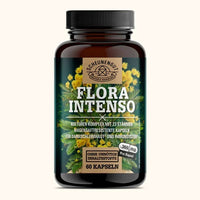
Our Flora Intenso contains both: 23 strains, of which 22 are bacterial strains plus the yeast Saccharomyces boulardii (500 million CFU per capsule). Because the capsule contains bacteria, the gap applies to the whole capsule. You cannot pick the yeast out.
Start during the course or wait until the end?
Both are common, and one of them is calmer. If you begin mid-course, with two or three antibiotic doses a day, every capsule has to be slotted between the tablets. Doable, but a bit of arithmetic. If you wait, you take the first capsule the day after the last tablet, with no overlap and no constant glancing at the clock. Simple.
Which route suits you depends on how reliably you keep to times. On shift work, with kids at the table or while travelling, waiting is the easier choice. In a regular routine with fixed meal times, an early start works fine too.
One thing holds either way: you finish the antibiotic in full and as prescribed, even if your gut grumbles. Cultures are a companion. They are no reason to skip a tablet or cut the course short.
What a day with antibiotic, capsule and magnesium looks like
An example with an antibiotic at 8 and at 20 o'clock, as many people are prescribed:
- During the course: 8 am antibiotic, as the leaflet says. Lunch at 12. At 2.30 pm one capsule of Flora Intenso with a glass of water, a good two hours after eating and more than five hours clear of both antibiotic doses.
- After the course: one capsule of Flora Intenso in the morning on an empty stomach with a glass of water, then breakfast. If your stomach is sensitive, take it with a meal.
- Magnesium: with gyrase inhibitors such as ciprofloxacin, it belongs at least two hours before or four hours after the antibiotic. In the example the window is at 4 pm: two capsules of our Magnesium Complex with 400 mg elemental magnesium. Magnesium contributes to normal muscle function. It sits happily alongside the cultures with no further gap.
The times are a pattern. Your antibiotic sets the grid, and your leaflet tells you whether a gap for minerals applies at all.
Does it help at all? What the research says and what stays open
Honestly: not clear-cut. In children, a large Cochrane review from 2019 came out rather positive, especially at higher daily amounts from about 5 billion CFU. In adults the evidence is mixed. Part of the medical community considers cultures after an antibiotic dispensable, because the gut flora usually recovers on its own.
Health claims for probiotics are not authorised in the EU. So we promise you no effect. We tell you what is inside, how to take it and what matters when choosing. The decision is yours, with your doctor or in the pharmacy, especially if you have a weakened immune system, a venous catheter or a yeast allergy.
Magnesium, iron, calcium and yoghurt: a different gap
Minerals are a chapter of their own. Calcium, magnesium, iron and zinc form compounds with some antibiotics that the body absorbs less well. This is best documented for gyrase inhibitors such as ciprofloxacin: minerals at least two hours before or four hours after. Milk and yoghurt count too. Take the antibiotic at the earliest four hours after dairy, and have milk only two hours after the tablet. Levofloxacin and moxifloxacin, according to the pharmacy literature, need no gap from calcium and milk.
For other drug groups, the times are in the patient leaflet. With every new prescription, ask briefly whether a gap applies to magnesium, iron, calcium, zinc and dairy. In the pharmacy that takes a minute. You will find more in our guide on supplements and antibiotics.
Does the pill still work despite an antibiotic?
Usually yes. A clear exception is rifampicin: it speeds up the breakdown of the hormones and can noticeably weaken contraception, so use extra protection until 28 days after you stop. For other antibiotics there is no established risk. It is different with diarrhoea or vomiting, because then the pill cannot be absorbed fully. In that case, add a barrier method. The authors of a German prescribing journal also advise this generally for the time you take antibiotics, simply to be safe.
Rebuilding your gut flora: what counts besides the cultures
Cultures need food. That means fibre: oats at breakfast, lentils in a stew, onions and leek in a salad, wholegrain bread instead of toast. If you add fermented foods such as sauerkraut, kefir or yoghurt, you bring extra variety to the plate. A yoghurt is no substitute for a supplement with 23 strains and 10 billion CFU per capsule, though; it delivers different amounts and a smaller selection.
Nobody can say in general how long the rebuilding takes. Statements range from a few days to several months, depending on the antibiotic, the length of the course and your gut. Manufacturers of yeast products give up to two weeks beyond the last tablet as a guide. For Flora Intenso there is no prescribed course length: with one capsule a day the pack lasts 60 days, which works out at 0.33 euros a day.
For women who have intimate flora in mind, there is also the Frauenflora complex with lactobacilli in gastro-resistant capsules. Both fit into the same daily plan.
What to look for in cultures after an antibiotic
- Variety instead of a single strain: An antibiotic hits many kinds of bacteria. A supplement with many strains covers a wider selection than a single one.
- CFU per capsule: some packs state the value per gram, others per day. What matters is the amount you actually swallow.
- Gastro-resistant capsule: it dissolves with a delay, so the cultures get through the stomach and arrive in the gut.
- Fibre on board: acacia fibre is a soluble fibre that people with fructose intolerance also tolerate well.
- Shell and additives: capsule shell without carrageenan and PEG, no colourings or fillers.
- Storage: cool, dry and away from sunlight. In a summer suitcase, take a second look.
Matching Products from Scheunengut
Flora Intenso is our culture complex for exactly this situation: 23 strains, of which 22 are bacterial strains plus Saccharomyces boulardii (500 million CFU per capsule), 10 billion CFU per capsule (100 billion CFU per gram of culture mix) and 320 mg acacia fibre. Gastro-resistant, without additives, colourings or fillers, every batch tested in an independent laboratory. One capsule daily with a glass of water, on an empty stomach or, if your stomach is sensitive, with a meal. A capsule also provides vitamins B2 and B6 (21 and 15 percent of the reference value): vitamin B2 contributes to the maintenance of normal mucous membranes, vitamin B6 contributes to the normal function of the immune system.
In the daily plan above, three things work together: Frauenflora for the intimate flora, Magnesium Complex with four magnesium sources and 400 mg elemental magnesium in two capsules, and Flora Intenso as the base. We have run Scheunengut since 2012, without investors and with a focus on pure raw-material quality.
Frequently Asked Questions (FAQ)
Can I take probiotics together with antibiotics?
Yes, but not in the same minute. For bacterial cultures, a gap of at least one to two hours from the antibiotic dose is usual. The yeast Saccharomyces boulardii generally does not need one. If you would rather skip the arithmetic, start the day after the last tablet.
Probiotics after antibiotics: when do I start?
Most simply the day after the last tablet. There is no overlap and you need no schedule. If you want to start earlier, take the capsule between the antibiotic doses, with at least one to two hours to spare.
How long do you take probiotics after an antibiotic?
There is no fixed duration. Manufacturers of yeast products give up to two weeks beyond the last tablet. Many people take cultures for several weeks, some permanently as a daily habit. One pack of Flora Intenso with 60 capsules lasts 60 days at one capsule a day.
Can I take magnesium together with antibiotics?
That depends on the antibiotic. With gyrase inhibitors such as ciprofloxacin: magnesium at least two hours before or four hours after. With other drugs the gap is in the patient leaflet. The same goes for iron, calcium and zinc. If in doubt, ask at the pharmacy.
Can I eat yoghurt with my antibiotic?
With some antibiotics yes, with others no. Gyrase inhibitors such as ciprofloxacin go in at the earliest four hours after dairy, and milk comes only two hours after. With many other drugs milk makes no difference. The leaflet says, or you ask.
Does the pill still work after an antibiotic?
In most cases yes. The exception is rifampicin, which needs extra contraception. With diarrhoea or vomiting the pill cannot be absorbed fully, so you add a barrier method. If in doubt, talk to your doctor.
Can I take Omni-Biotic or another probiotic without an antibiotic?
Yes. Cultures are not an accessory to antibiotics; many people take them as a fixed routine, while travelling, or to go with a high-fibre diet. You do not need the gaps from this guide then. With Flora Intenso you take one capsule daily.
Health notice: This guide is for general information purposes only and does not replace individual medical or pharmaceutical advice. Food supplements are not a substitute for a balanced, varied diet and a healthy lifestyle. If you have health concerns, are pregnant or breastfeeding, or are taking medication, please consult a doctor or pharmacist. How our guides are created →
Sources
- Notes that should not be missing (antibiotic dispensing, probiotics and gap) — Pharmacy Journal (Pharmazeutische Zeitung), 2020
- Gyrase inhibitors and polyvalent cations — Pharmacy Journal (Pharmazeutische Zeitung), 2008
- Probiotics for the prevention of pediatric antibiotic-associated diarrhea — Cochrane Database of Systematic Reviews, 2019
- Drug interactions between antibiotics and oral contraceptives — Prescribing in Practice (AkdÄ), 2021
- Gut cleansing with yeast or lactobacilli: yes or no? — PTAheute, 2022