



Yes, vitamin B12 and folic acid can be taken together, and B6 belongs on the team: all three take part in homocysteine metabolism. If you add folate, keep an eye on B12 too, because folate can hide a B12 deficiency in a blood count. The best time is the morning, with breakfast.
Yes, you can take vitamin B12, folate and vitamin B6 together, with the same meal and even from the same capsule. They don't get in each other's way. In your metabolism the three sit at the same workbench, and for one of them “together” is smarter than “alone”: folate. Why, you'll read in a moment.
For everyday life that means: one capsule of Vitamin B Complex with breakfast. It contains 51 µg of B12, 400 µg of folate and 9 mg of B6. How iron, magnesium and iodine fit alongside, what is on your plate and when a blood test beats any capsule is covered in the next sections.
The homocysteine team: what B12, folate and B6 do together
Homocysteine arises when the body processes protein. It either converts it back into methionine or breaks it down further. Both routes need B vitamins. The DGE describes a close interaction between B12 and folate: both take part in converting homocysteine to methionine, and in cell division and DNA synthesis. According to the DGE, vitamin B6 is involved in homocysteine metabolism together with riboflavin, folate and B12.
In the language of authorised claims: folate contributes to normal homocysteine metabolism. Vitamin B6 contributes to normal homocysteine metabolism. If one player is missing, the line stalls. With an inadequate B12 supply, homocysteine rises in the blood, as the DGE also notes.
Then there are the individual roles. Vitamin B12 contributes to normal red blood cell formation, folate to normal blood formation, and vitamin B6 likewise to normal red blood cell formation. Vitamin B12 and vitamin B6 contribute to the normal function of the nervous system. All three contribute to the reduction of tiredness and fatigue.
A homocysteine value on a lab report is a lab value, not a diagnosis. What it means for you is something your doctor interprets in context. Here we are talking about the metabolic pathway, not a number on a slip of paper.
Folate without B12? Then keep an eye on your B12
This is why the vitamins are better off as a duo than each on its own. Folate can hide a B12 deficiency in the blood count. That is how the MSD Manual puts it: the anaemia improves, but the neurological deficits keep progressing. Folate does not replace B12. On top of that, the liver stores B12, and the reserves last three to five years if no B12 comes in. A deficiency therefore shows up late.
So if you add folate, you don't leave B12 to chance. That applies especially to people on a vegan diet: the DGE advises them to take a B12 supplement permanently, because the vitamin is only present in relevant amounts in animal foods. In the Vitamin B Complex, both sit side by side, 51 µg of B12 (2,040% of the nutrient reference value) and 400 µg of folate (200%). If you notice tingling in your hands or feet, guessing won't help, a blood test will.
The daily plan: breakfast, lunch, evening
A plan that fits almost any day:
- Breakfast: one capsule of Vitamin B Complex with a large glass of water. The label says: in the morning, with enough liquid.
- Lunch: if you take iron, one tablet of iron bisglycinate with vitamin C with a meal. Not with coffee.
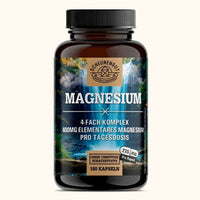
- Dinner or afterwards: magnesium, in our case 400 mg of elemental magnesium in two capsules of the Magnesium Complex, split if you like.
No guideline prescribes a fixed time. The morning has proved its worth because you tie the capsule to a habit: coffee machine on, capsule out. Some people find B vitamins stimulating and leave them out in the evening. B12, folate and B6 are water-soluble, so no gap between them is needed. You take all three in one go.
Iron, magnesium, iodine: what fits alongside the B complex
Iron. Iron contributes to normal formation of red blood cells and haemoglobin. B12 and folate work on the same building site, iron supplies the raw material. Our iron bisglycinate contains 20 mg of iron and 40 mg of vitamin C per tablet, and vitamin C increases iron absorption. Keep coffee and black tea out of that meal.
Magnesium. Magnesium contributes to normal muscle function and to the normal function of the nervous system. B6 and magnesium often appear together. We are not aware of any competition for absorption. Combination products with magnesium and B vitamins in one tablet are convenient, but taken separately you control each amount individually. On the label, the amount per daily dose is what counts.
Iodine. You take an iodine supplement according to its label. We are not aware of B vitamins and iodine getting in each other's way. With a thyroid condition, iodine belongs in medical hands, with or without a B complex.
Where B12, folate and B6 are found on your plate
All values come from the DGE's example calculations, per portion.
Vitamin B12: animal sources only
- Beef, lean, 100 g: 4.5 µg
- Salmon, cooked, 70 g: 2.87 µg
- Mozzarella, 100 g: 2.00 µg
- Camembert, 60 g: 1.86 µg
- Egg, boiled, 1 piece: 1.14 µg
- Milk or yoghurt, 150 g: 0.6 µg each
Folate: green vegetables lead
- Spinach, cooked, 150 g: 158 µg
- Lamb's lettuce, 100 g: 145 µg
- Peas, cooked, 150 g: 117 µg
- Kale, cooked, 150 g: 96 µg
- Red pepper, raw, 150 g: 83 µg
- Kohlrabi, raw, 100 g: 70 µg
Vitamin B6: vegetables, fish and meat
- Red pepper, raw, 150 g: 0.68 mg
- Pork, lean, 150 g: 0.49 mg
- Broccoli, cooked, 200 g: 0.47 mg
- Pollock, cooked, 150 g: 0.45 mg
- Spinach, cooked, 200 g: 0.44 mg
- Potatoes, cooked, 200 g: 0.27 mg
The sums don't work out for everyone. The German National Nutrition Survey puts average folate intake at 207 µg for men and 184 µg for women, against a recommended 300 µg. The DGE's rule for preparation helps: wash vegetables briefly, steam instead of boiling, don't keep them warm. For B12, there is no reliable source without animal foods, fermented foods and algae included.
Signs of deficiency: why you shouldn't interpret them on your own
Folate deficiency mainly disturbs cell division and growth and can lead to anaemia. With B12, tiredness, trouble with concentration and mood, and early losses in the nervous system are added, such as reduced position and vibration sense. For B6, the DGE names anaemia and neurological disorders, rarely diet-related. Risk factors include alcohol, liver disease, the pill, and medication for epilepsy or asthma.
These signs can point to a deficiency. They can just as easily come from lack of sleep, stress or something else entirely. The only way to know for sure is a blood test with your doctor. For B12, the DGE recommends a status marker such as holotranscobalamin or total B12 together with a functional marker such as methylmalonic acid or homocysteine. Stomach conditions in which intrinsic factor is missing, or bowel conditions, make B12 absorption harder. Your doctor's practice sorts that out, not a shop shelf.
Side effects and limits: what you should know
With vitamin B6 the trouble starts far beyond a capsule: the DGE names mild neurological impairment at more than 100 mg a day over the long term, amounts that only add up through supplements or medication. Our complex contains 9 mg of B6. For folate, the DGE distinguishes: natural folates from food are harmless according to current knowledge, whereas high intake of folic acid from supplements is different. The complex contains folate as 5-methyltetrahydrofolate, 400 µg.
With B12 you will wonder about the numbers: 51 µg against a reference value of 4 µg. That is deliberate. According to the MSD Manual, a high oral dose is absorbed by mass action even when intrinsic factor is missing. From food, B12 needs exactly that carrier. Sensitive stomach? Take the capsule with breakfast. Regular medication? Check with your doctor or pharmacist first.
Trying for a baby and pregnancy: folate matters
The DGE recommends that women who want to become or could become pregnant take 400 µg of folic acid a day, or equivalent doses of other folates, in addition to a folate-rich diet, starting at least four weeks before pregnancy and continuing through the first trimester. You agree dose and supplement with your gynaecologist or midwife. Skip liver during the first trimester, as the DGE advises.
Matching Products from Scheunengut
You get B12, folate and B6 together in one product from us. The Vitamin B Complex combines all eight B vitamins in bioactive form: B12 in three forms (methylcobalamin, adenosylcobalamin, hydroxocobalamin), B6 as pyridoxal-5'-phosphate, folate as 5-methyltetrahydrofolate. High-dose with 51 µg of B12, 400 µg of folate and 9 mg of B6 per capsule, plus myo-inositol, betaine and choline. One capsule in the morning; the tub of 180 capsules lasts 180 days. Vegan, made in Germany, without additives, colourings or fillers. Vitamin B12 has a function in cell division, and so does folate.
As additions to the daily plan: the iron bisglycinate with vitamin C (20 mg of iron, 40 mg of vitamin C per tablet, 240 tablets) and the Magnesium Complex (400 mg of elemental magnesium in two capsules, 180 capsules last 90 days).
Scheunengut has existed since 2012, without investors and with one focus: pure raw material quality. We have raw materials and finished products of every batch tested in independent laboratories.
Frequently Asked Questions (FAQ)
Can you take vitamin B12 and folic acid together?
Yes. They don't interfere, and in your metabolism they work closely together: both help convert homocysteine to methionine, and both take part in cell division. If you add folate on top, keep an eye on your B12 too, because folate can hide a B12 deficiency in a blood count. Our Vitamin B Complex puts both in one capsule.
When is the best time to take B6, B12 and folic acid?
Best in the morning with breakfast. Our Vitamin B Complex is made for that: one capsule in the morning with enough liquid. No guideline prescribes a fixed time. What matters more is tying the capsule to a habit so you remember it every day.
Can I take B12, folic acid, iron and vitamin D on the same day?
Yes, spread them across the day. The B complex goes with breakfast, iron with vitamin C goes with another meal, but never with coffee or tea. Vitamin D3 belongs with a meal that contains some fat. For iodine, follow the label of your iodine supplement, and with a thyroid condition your doctor decides.
Can I take magnesium together with B6 and B12?
Yes. We are not aware of any competition for absorption. Take magnesium with dinner or split into two portions, and the B complex in the morning. If you prefer a combination product with magnesium and B vitamins, compare the amount per daily dose on the label.
How do I recognise a B12 or folate deficiency?
You only know for sure from a blood test. Tiredness, tingling or trouble concentrating have many causes. For B12, labs measure total B12 and holotranscobalamin, plus methylmalonic acid and homocysteine. An unremarkable blood count is not enough for B12, especially if you also take folate.
Which foods contain B12, folate and B6?
B12 occurs in relevant amounts only in animal foods such as beef, salmon, eggs and dairy. Folate comes from lamb's lettuce, spinach, peas, kale and kohlrabi. You find B6 in peppers, fish, lean pork, broccoli and potatoes.
Do B6, B12 and folic acid have side effects?
For B6, the German Nutrition Society (DGE) names mild neurological impairment only at more than 100 mg a day over the long term; our complex contains 9 mg. If you take medication regularly, talk to your doctor or pharmacist before you start.
Health notice: This guide is for general information purposes only and does not replace individual medical or pharmaceutical advice. Food supplements are not a substitute for a balanced, varied diet and a healthy lifestyle. If you have health concerns, are pregnant or breastfeeding, or are taking medication, please consult a doctor or pharmacist. How our guides are created →
Sources
- Folate – Reference Values — German Nutrition Society (DGE), 2018
- Selected Questions and Answers on Folate — German Nutrition Society (DGE), 2018
- Selected Questions and Answers on Vitamin B12 — German Nutrition Society (DGE)
- Selected Questions and Answers on Vitamin B6 — German Nutrition Society (DGE), 2025
- Vitamin B12 Deficiency — MSD Manual Professional Edition