



For everyday B12 supply, oral intake via tablet, capsule, drops, or lozenge is the practical standard approach. The B12 injection, by contrast, is a medical intervention reserved for specific situations — not simply a stronger everyday option. The body reliably absorbs a share of even higher oral amounts, via two separate absorption pathways.
„The injection really works, you can forget about the tablets.“ You often hear sentences like this when the topic is vitamin B12 – and they prove remarkably persistent. But is it actually true? The short answer: for everyday supply, oral intake is the practical standard route – the B12 injection, by contrast, is a medical measure for certain situations, not a „stronger“ everyday remedy. We soberly separate the facts from the half-truths and show when each route makes sense.
The key points at a glance
- Oral intake (tablet, capsule, drops, lozenge) is the usual route for everyday supply.
- The B12 injection is a medical measure and is decided upon by a doctor.
- The body absorbs B12 orally via two mechanisms – even higher oral amounts are absorbed proportionally.
- Vitamin B12 contributes to normal energy-yielding metabolism and to normal red blood cell formation.
- Which route fits depends on the individual case and, for medical questions, belongs in a doctor's assessment.
What both routes have in common
Whether swallowed or injected, the goal is always the same – to supply the body with sufficient vitamin B12. In the EU it is approved: vitamin B12 contributes to normal energy-yielding metabolism, the normal function of the nervous system, normal psychological function and normal red blood cell formation. Vitamin B12 also contributes to the reduction of tiredness and fatigue. These functions presuppose an adequate supply and are not a promise of cure.
Put differently: the question „injection or tablet“ is not a question of whether B12 fulfils its functions – it does so regardless of the route. It is only a question of how it enters the body. And here the two routes differ on one decisive point: self-determination in everyday life versus a medical decision.
Oral intake: the everyday route
For the vast majority of people, intake by mouth is the practical standard. To understand why this works so well – contrary to the myth that tablets „aren't absorbed anyway“ – it is worth looking at absorption. The body takes up B12 via two mechanisms:
- Firstly, via a saturable transport route using the so-called intrinsic factor – this absorbs only a limited, small amount per portion.
- Secondly, via a passive uptake that works independently of this transport system and comes into play proportionally at higher amounts.
It is precisely this second, passive route that explains why even higher-dosed oral preparations reliably contribute to the supply. The advantages of the everyday route at a glance:
- Practical: can be done yourself at any time, without an appointment and without outside help.
- Flexible: available as a capsule, tablet, lozenge, spray or drops.
- Suited to daily life: easy to build into a fixed routine and easy to take along when travelling.
- Gentle: no injection site, no appointment, no waiting time.
- Affordable: oral preparations are straightforward and well suited to long-term use.
For the great majority who simply want to secure their supply – above all on a vegan diet – the oral route is therefore the obvious first choice. The DGE recommends that people on a vegan diet take a B12 supplement permanently. With us that is the Vitamin B Complex: 51 µg of vitamin B12 per capsule, in three forms at once, as methylcobalamin, 5’-deoxyadenosylcobalamin and hydroxocobalamin. You will find background on this in Covering vitamin B12 on a vegan diet. How to handle oral intake in practice is explained in Vitamin B12: when to take it? and how long to take it. Which dosage form suits you is shown in Capsule, tablet, powder or drops, and which B12 form to choose is clarified in B12 forms: methyl- vs. cyanocobalamin.
The B12 injection: a medical measure
The injection of vitamin B12 is chosen and carried out by medical professionals in certain situations. Whether an injection is an option is a medical decision that depends on the individual situation – for example on the absorption capacity in the digestive tract and on one's status. There are constellations in which uptake via the gut is limited; the oral route can then reach its limits. Whether that applies in an individual case, however, can be assessed only by a doctor.
Important and unambiguous: the B12 injection is not a „wellness boost“ for in between and not a do-it-yourself measure. It belongs in medical hands, and whether an injection makes sense is decided solely by the doctor.
Oral vs. injection – the classification at a glance
| Criterion | Oral intake | Injection |
|---|---|---|
| Administration | Yourself, in daily life | By a doctor |
| Decision | Freely chosen for supply | Medical, by a doctor |
| Typical use | Everyday supply | Individual medical situations |
| Forms | Capsule, tablet, drops, spray, lozenge | Injection |
| Effort | No appointment, no outside help | Appointment, professional administration |
The comparison shows: this is less a matter of „better or worse“ than of two different application contexts. The oral route is the route of everyday, self-determined supply. The injection is a tool of medical care for certain situations. This clear division of roles takes much of the supposed heat out of the debate.
Common assumptions fact-checked
Persistent myths surround the B12 injection. A sober look helps:
- „The injection works faster and is therefore better.“ A rapid intake is not inherently „better“ for a lasting supply. What counts in everyday life is continuous intake – and the oral route delivers that reliably.
- „Tablets aren't absorbed at all.“ That's not correct. The body takes up oral B12 via two mechanisms, including a passive uptake at higher amounts.
- „The injection is an energy kick.“ Vitamin B12 contributes to normal energy-yielding metabolism and to the reduction of tiredness and fatigue. That is a contribution within metabolism and not a caffeine effect.
- „I can inject it myself.“ No. The injection is a medical measure and belongs in professional hands.
Which route fits you?
The decision can be pinned to a simple guiding question: is it about everyday, self-determined supply – for example on a vegan diet – then oral intake is the usual and practical route. In everyday life that means: one capsule of Vitamin B Complex in the morning with plenty of fluid, done. If, on the other hand, a medical question is at stake – for instance a suspicion of limited absorption or a conspicuous status – then the assessment belongs in medical hands, which will then also decide on an injection. Do not guess here; instead seek medical advice. Whether a low supply is really present is best clarified beforehand by looking at the signs and by testing – see Vitamin B12 deficiency: signs. Anyone combining several preparations orally will find guidance in Combining supplements correctly, and a broad overview is given in B vitamins at a glance. In case of persistent complaints, please seek medical advice.
Matching Products from Scheunengut
Vitamin B Complex: All eight B vitamins in bioactive forms plus three co-factors: myo-inositol (50 mg), betaine (38 mg) and choline (20 mg). One capsule in the morning contains 51 µg of vitamin B12 in three forms, 400 µg of folic acid, 9 mg of vitamin B6 and 300 µg of biotin. The complex is high-dose, vegan and designed for stress, sport and a vegetarian or vegan diet. Made in Europe (DE, AT, CH +), free of carrageenan and PEG, every batch tested in an independent lab. According to the product page it costs €0.09 a day. Vitamin B12 contributes to the normal function of the immune system. Folate contributes to normal homocysteine metabolism. Biotin contributes to the maintenance of normal hair. If you are pregnant, breastfeeding or taking medication, talk to your doctor or pharmacist before taking it.
Iron Bisglycinate + Vitamin C: 20 mg of iron as a chelate bound to the amino acid glycine, plus 40 mg of natural vitamin C from rose hip. One tablet a day with a meal, so the 240 tablets in a tub last 240 days. Vegan and lab-tested. You supplement iron only when a need has been established. Iron contributes to normal formation of red blood cells and haemoglobin, and vitamin C increases iron absorption.
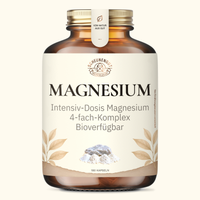
Magnesium Complex: Four magnesium sources, 400 mg of elemental magnesium from two capsules a day, vegan and lab-tested. Magnesium contributes to normal muscle function and to the normal function of the nervous system.
Scheunengut has made all of this since 2012, with no investors behind us and a focus on pure raw-material quality.
Frequently asked questions (FAQ)
Is the B12 injection better than tablets?
Not across the board. For everyday supply, oral intake is the usual, practical route, because the body absorbs B12 via two mechanisms – even higher amounts proportionally and passively. The injection is a medical measure for certain situations, for example with limited absorption. So it is less about better or worse than about two different application contexts.
Are vitamin B12 tablets really absorbed?
Yes. The body takes up oral B12 via two routes: a saturable transport route via the intrinsic factor, which absorbs only a little per portion, and a passive uptake that comes into play proportionally at higher amounts. It is precisely this passive route that explains why even higher-dosed oral preparations reliably contribute to the supply.
Can I inject vitamin B12 myself?
No. The B12 injection is a medical measure and belongs in professional hands – not do-it-yourself and not a wellness boost. Whether an injection makes sense is decided solely by the doctor on the basis of the individual situation. For everyday supply, oral intake is the self-determined route.
When is a B12 injection useful?
That is a purely medical decision. An injection may be considered when uptake via the gut is limited or when one's status requires it. Whether that applies in an individual case can be assessed only by a doctor. For plain everyday supply – for example on a vegan diet – oral intake is the usual route.
Health notice: This guide is for general information purposes only and does not replace individual medical or pharmaceutical advice. Food supplements are not a substitute for a balanced, varied diet and a healthy lifestyle. If you have health concerns, are pregnant or breastfeeding, or are taking medication, please consult a doctor or pharmacist. How our guides are created →
Sources
- Vitamin B₁₂ (Cobalamins) – Reference Values — German Nutrition Society (DGE), 2018
- Selected Questions and Answers on Vitamin B₁₂ — German Nutrition Society (DGE)
- Thiamine (Vitamin B₁) – Reference Values — German Nutrition Society (DGE)
- Maximum levels for vitamins and minerals in food supplements and fortified foods (press release on updated maximum level recommendations) — German Federal Institute for Risk Assessment (BfR), 2021
- Maximum Levels for Vitamins and Minerals in Food Supplements (BfR Opinion 014/2018, incl. B Vitamins) — German Federal Institute for Risk Assessment (BfR), 2018