



Yes, you can take copper and magnesium together, even with the same meal. No proven mutual inhibition is known, so you need no spacing. The real copper counterpart is zinc. With us, copper comes in a complex with manganese, for example in Venenkraft, and magnesium as a complex or as bisglycinate.
Yes, you can take copper and magnesium together, with the same meal and the same glass of water. We know of no documented mutual inhibition. Copper's counterpart is zinc, not magnesium. And you don't have to hunt for copper as a single capsule: in our range it sits at 250 µg where it fits with the other ingredients, for example in Venenkraft.
Why copper and magnesium don't get in each other's way
Look at the orders of magnitude. For magnesium, the German Nutrition Society (DGE) gives adults 350 mg a day for men and 300 mg for women. For copper it is 1.0 to 1.5 mg. That is a ratio of roughly 250 to 1. One is a bulk mineral, the other a trace element, and they work in different enzymes.
Magnesium is a cofactor of more than 600 enzymes. It is involved in muscle contraction, in nerve signalling and in bone turnover. Copper is also part of enzymes and plays a role in iron metabolism. Two toolboxes, hardly any shared screws. Even if you have taken both minerals side by side for years, say the Magnesium Complex in the evening and a multi-supplement in the morning, there is no reason to change your rhythm.
That is not proof of “zero interaction”. We haven't found a study that answers exactly this question. But we also know of no finding that would justify spacing the two apart.
The mineral that actually affects copper is zinc
If something grates with copper, it's zinc. A zinc supplement can lower copper absorption in the gut, especially at the amounts you reach with capsules. With zinc from normal food, hardly anything shows.
For your plan that means: if you take zinc, magnesium and copper on the same day, watch the zinc. You can safely ignore magnesium here. Amount and duration decide, not the time of day. One capsule in the morning and one in the evening won't solve it. How to put zinc and copper in proportion is covered in our guide to the zinc-copper ratio.
Where your copper comes from
Most of it comes from food. The DGE gives adults 1.0 to 1.5 mg of copper a day, and according to the National Nutrition Survey II (Nationale Verzehrsstudie II), women take in a median of 1.2 to 1.5 mg and men 1.5 to 1.8 mg. Copper is found in cocoa, nuts, oilseeds, wheat germ and wheat bran, in pulses and in offal such as liver. Cereal products, green vegetables, coffee and tea also contribute their share, and few people think of coffee.
If you eat a varied diet and now and then have wholemeal bread, a handful of nuts or dark chocolate on your plate, you collect your copper along the way. A complex is then the building block that adds to your food. Our Venenkraft delivers 250 µg of copper with two capsules, which is 25% of the reference value, and the copper is no mere extra there: it is part of the recipe together with manganese, because both suit connective tissue.
It's different if you take high-dose zinc for weeks. Then it makes sense to keep an eye on your copper intake and to ask your doctor whether there is a need.
What magnesium and copper contribute in the body
The EU authorises a series of claims for both. Magnesium contributes to normal muscle function. Magnesium contributes to the normal functioning of the nervous system. Magnesium contributes to normal energy-yielding metabolism. Magnesium contributes to a reduction of tiredness and fatigue.
Copper contributes to the maintenance of normal connective tissue. Copper also contributes to normal energy-yielding metabolism and to the normal functioning of the nervous system. Manganese, the partner in the Venenkraft recipe, contributes to normal connective tissue formation.
You can see the overlap in energy metabolism and the nervous system. You can't simply add the contributions up, because the body doesn't calculate that way. The two just have their own jobs in the same gearbox.
How to fit both into your day
- Breakfast as your anchor: a slice of bread, the Magnesium Complex with two capsules (400 mg of elemental magnesium, any time of day) and the first capsule of Venenkraft.
- Evening: the second capsule of Venenkraft. According to the serving recommendation it is meant for “1x in the morning and 1x in the evening”.
- Prefer glycine? You take the magnesium bisglycinate as three capsules a day with meals. One with breakfast, one with lunch, one with dinner, which makes 360 mg of elemental magnesium.
- Spacing? Not needed between copper and magnesium.
Spacing does make sense with medicines. If the package leaflet says minerals need a gap, that applies to magnesium and to copper too. If in doubt, ask at the pharmacy.
How to add up your daily amounts
With copper, everything counts. An example: according to the survey, a woman takes in a median of 1.2 to 1.5 mg from food. Add Venenkraft with 0.25 mg and she is at about 1.45 to 1.75 mg. But if you take a multimineral, a vein complex and a water-balance complex side by side, go through all the labels and add up the micrograms.
With magnesium the sum is simpler. The reference value is 375 mg. The Magnesium Complex covers 107% of it with 400 mg, the magnesium bisglycinate 96% with 360 mg. Wholemeal bread, oats, nuts and pulses come on top from your food.
Who this combination is relevant for
You take magnesium daily because you train a lot, work shifts or want to wind down in the evening, and on the label of another supplement you stumble over copper. That is the most common case, and it needlessly worries many people into thinking they now have to sort capsules, fix clock times and leave hours between intakes before they allow themselves a coffee or breakfast. Your magnesium doesn't bother the copper. Really.
The second case is for everyone who is on their feet a lot and reaches for a vein complex. Here copper is part of the recipe, and the magnesium just runs alongside. The third: you take zinc in a high dose over a longer period. Here copper is the issue.
Who should look closely at copper
For children and adolescents, a copper supplement doesn't belong on the shelf without medical advice. Infants and small children are particularly sensitive. With liver disease and with disorders of copper metabolism such as Wilson's disease, any additional source of copper belongs in medical hands.
Here too: read the label and add up the amounts from all your supplements. The European Food Safety Authority (EFSA) has assessed 5 mg of copper a day from all sources as the tolerable total for adults. With food and a complex like Venenkraft you are far away from that order of magnitude.
Matching Products from Scheunengut
We don't carry a pure copper product. Copper sits in our range where it belongs: in two complexes with manganese, and on top you get magnesium in two forms. Scheunengut has existed since 2012, without investors and with a focus on pure raw material quality. Every batch is tested in an independent laboratory, production takes place in Germany, and everything is filled into vegan capsule shells without additives, colourings or fillers.
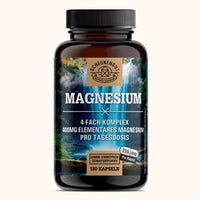
Magnesium Complex: four bioactive magnesium sources (tri-magnesium dicitrate, magnesium oxide, magnesium malate, magnesium bisglycinate) with 400 mg of elemental magnesium per daily dose from two capsules, at any time of day. Magnesium contributes to the normal functioning of the nervous system and to normal muscle function.
Magnesium bisglycinate: the chelate of magnesium and glycine, vegan and gentle on the stomach, with 360 mg of elemental magnesium a day from three capsules with meals. Magnesium contributes to a reduction of tiredness and fatigue.
Venenkraft: high-dose with 570 mg of rutin from the Sophora japonica blossom, 420 mg of sweet clover and 160 mg of horse chestnut extract (20% aescin) in two capsules, plus 250 µg of copper and 500 µg of manganese, 25% of the reference value each. Copper contributes to the maintenance of normal connective tissue, manganese to normal connective tissue formation. The Sophora blossoms come from our farmer in Japan, sweet clover and horse chestnut from Bulgaria. The tub of 120 capsules lasts 60 days at two capsules a day, made for everyone who is on their feet a lot.
Wasserausgleich: an herbal blend with 500 mg of nettle leaf extract, 405 mg of horse chestnut extract and 405 mg of red vine leaf extract at the maximum portion of three capsules, also with 250 µg of copper and 500 µg of manganese. The nettle comes from a German farmer, the vine leaf from a winegrower in Italy.
Frequently Asked Questions (FAQ)
Can you take copper and magnesium together?
Yes. No proven mutual inhibition is known, and you don't need any spacing. Take both with the same meal or spread them over the day as suits you. Keep an eye on the amounts on the label.
Can you take magnesium and copper at the same time, or is it better to separate them?
At the same time is fine. You don't have to separate them. Spacing only makes sense with medicines, if the package leaflet asks for it with minerals, and with high-dose zinc, where amount and duration matter, not the time of day.
When is the best time to take copper with magnesium?
Breakfast or dinner both work. The Magnesium Complex can be taken at any time of day, the magnesium bisglycinate you spread over your meals. For Venenkraft you take one capsule in the morning and one in the evening.
How much copper can I take in addition to magnesium?
As a guide, the DGE gives 1.0 to 1.5 mg of copper a day from all sources, most of it from food. Our Venenkraft delivers 250 µg of copper with two capsules, Wasserausgleich also 250 µg with three capsules, 25% of the reference value each. The magnesium doesn't change that sum.
Do I need copper if I take zinc and magnesium?
Not automatically. Magnesium plays no part in it. With high-dose zinc over several weeks, copper absorption can drop. Then it is worth looking at your copper intake, ideally with medical advice and a blood count.
Does a combination product with copper and magnesium make sense?
It can, if both amounts suit you. Check each one on the label. A single magnesium product such as the Magnesium Complex or the magnesium bisglycinate, on the other hand, is easier to dose flexibly, and the copper comes from a complex that pairs it with manganese and plant compounds.
Who should skip copper from capsules?
Children and adolescents, and anyone with liver disease or a copper metabolism disorder, unless a doctor says otherwise. With medication, pregnancy and breastfeeding, ask at the pharmacy first.
Health notice: This guide is for general information purposes only and does not replace individual medical or pharmaceutical advice. Food supplements are not a substitute for a balanced, varied diet and a healthy lifestyle. If you have health concerns, are pregnant or breastfeeding, or are taking medication, please consult a doctor or pharmacist. How our guides are created →
Sources
- Maximum level proposals for copper in foods including food supplements — German Federal Institute for Risk Assessment (BfR), 2021
- Copper intake: essential in traces, risky in larger amounts — German Federal Institute for Risk Assessment (BfR), 2023
- Re-evaluation of the existing health-based guidance values for copper and exposure assessment from all sources — EFSA Journal 21(1):7728, 2023
- Copper, manganese, chromium, molybdenum: reference values — German Nutrition Society (DGE)
- Magnesium: reference values — German Nutrition Society (DGE), 2021