



Yes, you can take magnesium and omega-3 together. They belong to different classes of substance, and the sources we read describe no interaction. What matters is the meal: take omega-3 with food that contains fat, and add the magnesium to it or take it later in the evening. Split larger magnesium amounts into two portions.
Yes, you can take magnesium and omega-3 together, with the same evening meal and the same glass of water. They don't get in each other's way, and leaving two hours between them gains you nothing. One tip does count: omega-3 belongs with a meal that contains fat.
Many people ask in the same breath about the whole stack of vitamin D, K2, zinc and Q10. There's a daily plan for that below. The idea behind the three-supplement basics is explained in the guide “The Basic Trio: Understanding D3, Omega-3 and Magnesium”. This one is about timing, and about what can share a plate.
Why a mineral and a fat don't slow each other down
Magnesium is a mineral. Omega-3 from fish or algae oil, more precisely EPA and DHA, is a fat. Two classes of substance, no fight over the same door. The summary of the European Food Safety Authority (EFSA) assessment on EPA and DHA and the paper from the German Federal Institute for Risk Assessment (BfR) on magnesium mention no interaction between the two. We know of no study that measures this exact pair against each other. That doesn't prove there is none. In everyday terms, it's a green light.
With omega-3, something else decides: the food that comes with it. For omega-3 in ethyl ester form, a common fish-oil form, the literature describes a dependence on high-fat meals, because the body needs the pancreatic fat-digesting enzyme to deal with it. In a study of 54 overweight adults, only 3 of 50 participants taking ethyl esters absorbed at least half as much in the low-fat phase as in the high-fat phase. It was a manufacturer-funded study and appears here only as evidence for the pattern.
So the fatty meal is the lever. The magnesium simply joins you at the table.
What does each of them do?
Magnesium contributes to normal muscle function. Magnesium contributes to the normal functioning of the nervous system and to normal energy-yielding metabolism. Magnesium also contributes to the reduction of tiredness and fatigue.
EPA and DHA contribute to the normal function of the heart. This applies to a daily intake of 250 mg of EPA and DHA. DHA contributes to the maintenance of normal brain function. DHA contributes to the maintenance of normal vision. Both statements require 250 mg of DHA a day. You need to find those amounts on the label.
The jobs barely overlap. Magnesium works in muscle and nerve, EPA and DHA in heart, brain and eye.
How to spread both across your day
The easy way: everything with the evening meal. Omega-3, magnesium and, if you take them, vitamin D and Q10 all sit next to your plate. It works best when something warm with oil, cheese or fish is on the table anyway.
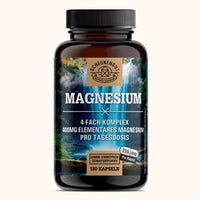
The split way: omega-3 with breakfast or lunch, magnesium after dinner. It pays off with larger amounts of magnesium, because the BfR recommends spreading the daily amount from supplements across two or more portions, so half goes to breakfast and half to the evening. For omega-3, the morning has another advantage: if fish oil repeats on you, you'll prefer it at breakfast to just before bed. The Magnesium Complex fits this plan: two capsules together deliver 400 mg of elemental magnesium, one with breakfast and one after dinner.
What counts as fat? An egg, a spoonful of olive oil, a handful of nuts, cheese, oily fish. A glass of juice on its own doesn't. Muesli with yoghurt and nuts does. No guideline prescribes a set time of day. You just need a meal you don't skip. Regularity beats any particular hour.
When magnesium on its own fits best is covered in the guide “Magnesium: Morning or Evening?”. For omega-3 timing, see “Omega-3: When Is the Best Time to Take It?”.
Adding vitamin D, K2, zinc or Q10: what stays the same?
Vitamin D. It's fat-soluble, so it goes with the same meals as the omega-3. Magnesium belongs too: a review describes that the enzymes that convert vitamin D need magnesium as a cofactor. Vitamin D contributes to the maintenance of normal bones. Vitamin D contributes to the normal function of the immune system. Our Vitamin D3 Depot with K2Pure® delivers 5,000 IU of vitamin D3 and 100 µg of vitamin K2 (MK-7) in a single tablet that you take only every 5th day, with the meal that contains fat. More on the pair in “Taking Magnesium and Vitamin D Together? How It Fits”.
K2. The body also absorbs vitamin K to different degrees depending on the food matrix, above all the fat. Vitamin K contributes to the maintenance of normal bones. Vitamin K contributes to normal blood clotting. That's why you speak to your doctor's practice if you take anticoagulants, before a K2 supplement joins your plan.
Zinc. A metabolic study of 25 postmenopausal women found a falling magnesium balance at 53 mg of zinc a day over 90 days. At 3 mg it was higher. So add up the zinc in all your supplements. As far as we know, zinc and omega-3 don't interfere, but the pair zinc and magnesium has its own guide: “Can You Take Zinc and Magnesium Together?”.
Q10. It's fat-soluble. In a Japanese study, the gut absorbed Q10 better after a meal. Q10 therefore travels with omega-3 and vitamin D, not with the magnesium. Our coenzyme Q10 delivers 200 mg per capsule, 98% ubiquinone from plant-based fermentation: one capsule with the fatty meal, next to the omega-3. How Q10 and omega-3 work together is covered in “Combining Coenzyme Q10 & Omega-3 for Your Heart”.
Already taking a combination product? Then add up the labels
Combination capsules with omega-3, D3, K2 and magnesium are handy. A second look is still worth it, because the label of a combination product carries several amounts that you have to count into your daily plan. First: how much EPA and DHA is actually in there? The front of the pack often shows the amount of fish oil, while EPA and DHA appear smaller in the nutrition table. Second: how much magnesium comes with it? In one survey, for each of magnesium, zinc, vitamin C and vitamin E, between 11 and 16 per cent of supplement users took the nutrient from two to four products. Stack a combination product and a magnesium capsule and you reach a double portion faster than you think.
An extra Q10 fits alongside such a product, as long as you take it with a meal and there isn't already a second Q10 in the combination product.
How much of each is enough?
Omega-3. For EPA and DHA together, EFSA gives 250 to 500 mg a day as a recommendation for European adults. It saw no safety concerns up to about 5 g a day from supplements, and up to 1.8 g for EPA alone. According to EFSA, long-term intake of up to about 5 g also did not raise the risk of bleeding. If you take anticoagulants, ask first anyway, and likewise before surgery.
Magnesium. The German Nutrition Society (DGE) gives 350 mg for men and 300 mg for women as an adequate intake, from food and supplements together. Fish is itself a source of magnesium, alongside wholegrains, pulses, green leafy vegetables, nuts and seeds. Split larger amounts from supplements across at least two portions. Loose stools are the first sign of too much. Then you cut the amount. With kidney disease or long-term medication, clear supplements with your doctor's practice beforehand.
What to look for when buying omega-3 and magnesium
With omega-3, what counts is the sum of EPA and DHA per daily dose, not the figure “1,000 mg fish oil”. After that comes the form: triglycerides or ethyl esters, fish or algae oil. How to judge quality is covered in “Recognising Omega-3 Quality: Totox, EPA/DHA Content & Purity”. With ethyl esters, the fatty meal matters even more.
With magnesium, what counts is the number behind “elemental magnesium”, not the weight of the compound. Magnesium citrate or bisglycinate weigh more than the magnesium in them, so a capsule labelled “1,000 mg magnesium citrate” delivers far less than 1,000 mg of magnesium. Read the figure per daily dose, not per capsule. With the Magnesium Complex it is stated openly: 400 mg of elemental magnesium per daily dose, and with the Magnesium Bisglycinate it is 360 mg. The shorter the ingredient list, the better.
Matching Products from Scheunengut
We don't sell a standalone fish or algae oil. Omega-3 with DHA is in our nursing complex Mamasmilch: per daily dose, three capsules, it delivers 300 mg of omega-3, of which 30 mg DHA, plus 900 mg of fenugreek seed extract, fennel, choline, iron, folic acid and vitamin B12 as methylcobalamin. It is put together for the breastfeeding period.
For the magnesium side we have two options. The Magnesium Complex combines four magnesium sources and delivers 400 mg of elemental magnesium per daily dose, two capsules. High-dose, openly declared. The Magnesium Bisglycinate is chelated, vegan and gentle on the stomach, and delivers 360 mg of elemental magnesium a day from three capsules. Split the daily amount across two meals, which is kinder on the gut.
For vitamin D there's the Vitamin D3 Depot with K2Pure®: 5,000 IU of vitamin D3 and 100 µg of vitamin K2 as MK-7 in one vegan tablet that you take only every 5th day. A tub of 180 tablets therefore lasts 900 days. It's fat-soluble, so it belongs with the same meal as the omega-3. The high-dose depot isn't suitable for pregnant or breastfeeding women, children or adolescents.
Then there's the Coenzyme Q10: 200 mg per capsule, 98% ubiquinone from plant-based fermentation, vegan, one capsule a day.
Scheunengut has been around since 2012, without investors in the background, with a focus on pure raw-material quality. Every batch goes to an independent laboratory. You'll find the current report on the product page.
Frequently Asked Questions (FAQ)
Can you take magnesium and omega-3 together?
Yes. Magnesium is a mineral, omega-3 is a fat, and the sources we read describe no interaction between the two. Take them with the same meal or separately, whichever suits your day. The only thing that matters is that the omega-3 goes with a meal that contains some fat.
Can you take vitamin D, magnesium and omega-3 together?
Yes, all three get along. Put the vitamin D and omega-3 with the fattiest meal of the day and add the magnesium to it or take it later in the evening. Magnesium also helps the body activate vitamin D, as a 2018 review describes.
When is the best time to take magnesium and omega-3?
Whenever you won't forget. Omega-3 belongs with a meal that contains fat: breakfast with an egg or cheese, lunch or dinner. Magnesium suits the evening. Split larger amounts into two portions.
Vitamin D3, K2, magnesium and omega-3: what do I need to watch?
Vitamin D and K2 are fat-soluble, so like the omega-3 they go with a meal that contains fat. Magnesium is independent of that. If you take anticoagulants, talk to your doctor's practice before starting any vitamin K supplement, because vitamin K contributes to normal blood clotting.
Which Q10 suits a combination product with omega-3, D3, K2 and magnesium?
Any that fits your meal, because we know of no interaction. Q10 is fat-soluble and absorbed better with food. Our coenzyme Q10 is ubiquinone: 200 mg per capsule, 98% ubiquinone from plant-based fermentation. Check first whether your combination product already contains Q10, and add up the magnesium on all your labels.
Can I take magnesium, zinc and omega-3 together?
With omega-3 and magnesium there is nothing to watch. With zinc, the amount deserves a look: in a metabolic study, magnesium balance after 90 days was lower on 53 milligrams of zinc a day than on 3 milligrams. Add up the zinc in all your supplements.
How much omega-3 and magnesium a day makes sense?
For EPA and DHA, EFSA gives 250 to 500 milligrams a day as a recommendation for adults. It saw no safety concerns up to about 5 grams a day. For magnesium, the DGE's estimated value is 350 milligrams for men and 300 for women, from food and supplements together. Split larger amounts of magnesium from supplements across two portions.
Health notice: This guide is for general information purposes only and does not replace individual medical or pharmaceutical advice. Food supplements are not a substitute for a balanced, varied diet and a healthy lifestyle. If you have health concerns, are pregnant or breastfeeding, or are taking medication, please consult a doctor or pharmacist. How our guides are created →
Sources
- Scientific Opinion on the Tolerable Upper Intake Level of eicosapentaenoic acid (EPA), docosahexaenoic acid (DHA) and docosapentaenoic acid (DPA) — EFSA Panel on Dietetic Products, Nutrition and Allergies (NDA), 2012
- A novel omega-3 free fatty acid formulation has dramatically improved bioavailability during a low-fat diet compared with omega-3-acid ethyl esters: the ECLIPSE study — Davidson MH et al., Journal of Clinical Lipidology, 2012
- Regulation (EU) No 432/2012 establishing a list of permitted health claims made on foods, other than those referring to the reduction of disease risk and to children's development and health — European Commission, Official Journal of the EU, 2012
- Maximum level proposals for magnesium in foods including food supplements — German Federal Institute for Risk Assessment (BfR)
- Magnesium – Reference values for nutrient intake — German Nutrition Society (DGE), 2021
- Role of Magnesium in Vitamin D Activation and Function — Uwitonze AM, Razzaque MS, Journal of the American Osteopathic Association, 2018
- A moderately high intake compared to a low intake of zinc depresses magnesium balance and alters indices of bone turnover in postmenopausal women — Nielsen FH, Milne DB, European Journal of Clinical Nutrition, 2004